Steven D. Brewer

← Home About Archive Photos Replies Subscribe Also on Micro.blog
  • The Hero, Demon Lord, and Friends

    rosary

    Most mornings, I write a brief story fragment for Wandering Shop Stories as a warm-up for my day’s creative activities. Sometimes, I use these directly as a rough draft or outlining tool for my current works-in-progress. Often, they’re just one-offs or fan fiction/literary canon of my existing work.

    Since January, however, I’ve been struggling. I really haven’t hit my stride writing since my son was hospitalized. We’ve had a lot of stuff going on and my head just wasn’t in the right place. Some days, I couldn’t post anything at all. When I could, it often wasn’t until late at night. And I was frequently dissatisfied with the quality of what I was writing.

    Things have been getting better. And just recently, I’ve finally felt like I’m starting to hit what I’m aiming at.

    Last fall, before things went south, I wrote a few story fragments about the Hero and the Demon Lord. Here is the first series:

    “What’s even the point of this?” the Demon Lord said.
    “Ssh,” said the Hero as he cast his line out again.
    They sat together at the shore of the lake. There was a quiet plunk as the bobber landed in the water. Ripples radiated out and then settled down.
    “You know I can just cast death on the fish and…”
    “You shall do no such thing.”
    A ripple appeared around the bobber. Once. Twice. Then it dove under the water.
    The Hero pulled back on the rod. The bobber and hook popped up, bait gone. The Hero pulled another worm out of the bait can.
    “At this rate, we’ll never get lunch,” the Demon Lord said.
    “Look in the basket under your seat,” the Hero said.
    The Demon Lord pulled out the basket and opened it.
    “Sandwiches?”
    “And beer. Isn’t this better than fighting to the death?”

    “What kind of sandwich is this?” the Demon Lord asked.
    “It’s a tasty sandwich,” the Hero explained helpfully
    The Demon Lord unwrapped it and inspected it skeptically.
    “Try it!” the Hero encouraged.
    The Demon Lord took a small bite. And then a larger one.
    “An interesting flavor…” he said, as he chewed.
    “Right?”
    “So what is it?”
    “It’s bang bang chicken.”
    “You made this yourself?”
    “Oh, no. My mother made it.”
    “Your mother!?”
    “Only the best for my friends.” The Hero smiled. “At least I hope we’ll soon be friends.”
    The Demon Lord scowled.

    “Well,” the Demon Lord said, getting to his feet. “It’s been fun, I guess…”
    “You’re not going to eat and bolt, are you?” the Hero said, pained.
    The Demon Lord settled back into his seat, grumbling.
    “Look!” he growled. “Maybe you don’t have anything better to do all day, but I…”
    “Pish posh,” the Hero said, casting the line again. “Your minions can run things just fine without you for an afternoon. When was the last time you took a day for yourself?”
    “But…”
    “Besides, you haven’t had dessert yet.”
    “Dessert?”
    The hero gestured and a group of people approached.
    Carrying a cake with candles, they began to sing Happy Birthday.
    “It’s not my birthday!” the Demon Lord barked.
    “Do you even have a birthday?”
    “Well, no…”
    “So, today is as good as any.”
    “What kind of cake is it?” he said, eyes narrowed suspiciously.
    “Why, devil’s food. Of course!”

    “Blow out the candles! Blow out the candles!” everyone called.
    The Demon Lord scowled, but then blew out the candles and everyone clapped.
    “Are you really sure that’s sanitary?” he mumbled, as they produced a stack of paper plates and plastic forks.
    “Well?” asked the Hero.
    “Well, what?”
    “Aren’t you going to cut the cake?”
    “With what?”
    “Ah! I thought you’d never ask!” the Hero laughed. “Here!”
    The Hero offered the Demon Lord an elaborate knife. It seemed to glow blue with an inner light.
    The Demon Lord eyed it suspiciously.
    “What is that?” he asked.
    “It’s Cakecrist,” the Hero said. “The Frosting Cleaver — Made by the elves, you know.”
    The Demon Lord extended a finger and tentatively touched the knife. There was a spark and a curl of smoke rose up. He jerked his hand back.
    “I think I’ll let you cut the cake,” the Demon Lord said.

    The Hero stood on the dock and watched while the firemen worked to contain the raging inferno where the lake cabin had once stood.
    “I’m afraid it’s a complete loss,” the Captain said.
    “It’s not a complete loss,” the Hero clarified. “We learned a lot.”
    “What did we learn?”
    “Well… We learned he doesn’t like fishing and he likes cake. Oh! And that he hates surprises.”
    The Captain stared at the Hero for a moment, then sighed and looked away.
    “It was bound to end this way,” he said.
    “What do you mean?” the Hero said “End? We’ve got another date next week!”

    The Hero and Demon Lord are tropes from Japanese manga. They appear constantly in all sorts of different forms. I’m by no means the first to “ship” the Hero and Demon Lord. In Gachi Koi Maou-Sama, for example, the Demon Lord is a cute girl that has a crush on the Hero. There are undoubtedly dozens — or hundreds — of manga that have the Hero and Demon Lord as characters. Sometimes they act according to their stereotypical nature but, just as often, they’re used to subvert the standard paradigm and do something unexpected.

    Just recently, I decided to pick them up again and I’ve been pleased with some of the results — as pleased as with anything I’ve written for a long time.

    After vanquishing the dread Spectre of Despair, the hero was feted with a parade through the town. As he passed by, a boy called out from the crowd.
    “Hero! Hero! What’s the name of your sword?”
    The hero paused a moment, then replied, “It doesn’t have a name. It’s just my sword.”
    “Awww!” the boy said, disappointed.
    “I’ll tell you what,” the hero said. “If you think of a cool name, I’ll name my sword that in your honor.”
    The boy’s face lit up with excitement.
    The hero waited while the boy wracked his brain for a cool name. The crowd grew silent with anticipation.
    “I’ve got it!” the boy crowed. “Swordy McSwordface!”
    “Swordy McSwordface! Swordy McSwordface!” the crowd chanted.
    The hero drew Swordy McSwordface and broke the blade over his knee.
    “I’ll get a new sword,” he said.

    The Hero arrived to visit the Demon Lord for coffee. He was ushered into the Demon Lord’s breakfast nook. The Demon Lord looked up from his paper and warmly greeted the Hero.
    “How would you like your coffee?” asked the maid. She was a charming lass of 16 or 17 with rosy cheeks.
    “I’ll take it with a little cream,” said the Hero.
    “And would you care for some coffee cake?”
    “Yes, thank you.”
    She made a bob, backed away from the table with her eyes downcast, then turned and left the room.
    “So…” the Demon Lord asked. “What do you think of my new monster?”
    “Monster?” The Hero regarded him quizzically. “What monster?”
    The Demon Lord pointed after the maid.
    “Her? But she’s just a girl!”
    “Exactly,” the Demon Lord exulted.

    “What!?” The Captain of the Holy Order of Knights was incredulous. He stared disbelievingly at the knight who had just delivered the report. “Did I hear you correctly? You’d better repeat that.”
    “I said,” the knight reiterated, “that the Hero is having breakfast with the Demon Lord.”
    The Captain rubbed his hand all over his face as he tried to digest this.
    “Who told you this?” he asked finally.
    “The Hero told me.”
    “The Hero told you? Himself?”
    “Yes.”
    “What did he say, exactly.”
    “To the best of my recollection, he said, ‘I’m having breakfast with the Demon Lord.'”
    “Hmm. No chance of a misunderstanding? He didn’t say, for example, ‘I’m having breakfast with the semen gourd’?”
    “No. I also saw him go into the Demon Lord’s castle.”
    The Captain sighed.
    Just then the Hero entered.
    “Did you really have breakfast with the Demon Lord?” the Captain asked.
    “Yes,” the Hero replied. “He showed me his new monster.”
    “Oh! You were collecting intelligence! How scary was the monster?”
    The Hero caught sight of his reflection in a mirror and wiped a bit of lipstick off his cheek.
    “Terrifying!” he answered, in a low voice.

    The Demon Lord chuckled, rubbing his hands together. The Maid touched up her lipstick using the mirror in a compact.
    “Did something good happen?” asked Jaygor.
    “Everything is going according to plan!”
    The Demon Lord clenched his fist. “Soon the Hero will be on his knees, nothing more than a quivering mass of gelatinous slime!”
    “Pardon me, Demon Lord,” the Maid said. “I think your plan will have a better chance of success if I can make a few purchases.”
    “Oh?” he said, interested.
    “Yes. Just a few details, really — to enhance the effect.”
    “How much will all this cost?” asked Jaygor.
    The Maid batted her eyes. “Hardly anything!” she said.
    The Demon Lord got out his billfold and began to extract some bills, but the Maid reached over and pulled out his credit card.
    “I’ll be back later,” she said, and blew him a kiss. She slipped out the door toward town.
    The Demon Lord replaced his wallet. “This is going to be great!” he said as she left.
    Jaygor just rolled his eyes.

    “Hello?” the Hero called. His voiced echoed through dark, empty corridors.
    “This way,” said Jaygor, unexpectedly from the side.
    The Hero jumped, but then followed Jaygor through the twisting passages of the dungeon.
    “Say…” he said, after a short time. “So why are you all down here?”
    “I’ll leave that to the Demon Lord to explain,” said Jaygor. The Hero detected a note of bitterness in his tone.
    They arrived in a dimly-lit chamber carved out of the living rock. The Demon Lord was seated, uncharacteristically, at a small wooden table.
    “Would you like some coffee?” asked the Maid.
    “Yes, please,” the Hero said.
    There was silence for several moments, as the Hero struggled to articulate the question.
    “I had to rent out the Black Castle,” the Demon Lord said.
    “Oh?” said the Hero.
    “I became over-extended on my credit card,” the Demon Lord said.
    Jaygor stared daggers at the Maid.
    “How was I supposed to know that magic beans were so expensive?” the Maid said, pouring the coffee.

    The Demon Lord came to his breakfast table in the dungeon. The Maid poured coffee while Jaygor brought him his morning paper. He unfolded the paper, then squinted, trying to read the indistinct print in the dim light.
    “Why do you still read a paper, Lord?” asked Jaygor. “Why not use a magic scrying glass or something?”
    The Demon Lord smiled.
    “It’s something you young people can’t understand,” he mused. “The sound of the rustling paper… The feel of newsprint… The smell of the ink…”
    He unfolded the paper the rest of the way, then scowled. Inside, there had been a print registration error and the text was unreadably blurry.
    “Jaygor!” he barked.
    “Yes, Lord!”
    “Bring me my scrying glass!”
    “At once, Lord!”

    Just recently, I introduced a new character: the Saintess. The Saintess is also a tropey character from manga.

    The Hero and Saintess were deep in the Forbidden Forest.
    The Saintess pulled out the map and studied it for a minute, then finally threw her hands up.
    “This is hopeless!” she said. “Admit it! We’re lost!”
    “What do you mean?” asked the Hero.
    “We have no idea where we are!”
    “We’re right here!” the Hero said, pointing down.
    “But where is ‘here’?” she pressed.
    “The Forbidden Forest?”
    “Argh!” She gnashed her teeth.
    “Look!” the Hero said. Up ahead, they could see a sign.
    The Saintess made a glad cry and ran forward to see what it said.
    The Hero strolled up to the sign. It said “Forbidden Forest.”
    “See?” he said. “I was right!”
    “I hate you,” she said.

    The Hero and the Saintess followed a dark, winding path under a canopy of immense trees draped with moss and vines.
    “Why do they call it the ‘Forbidden Forest?'” asked the Hero.
    “The Forest is a queer place,” the Saintess said. “Everything in it is very much more alive, more aware of what is going on, so to speak.”*
    “So it’s ‘woke,’ is what you’re saying?”
    The Saintess started.
    “Well… That’s not really…”
    The Hero stretched his arms. “It sounds like my kind of place!”

    *Note: The statement by the Saintess about the Forest is a direct quote from Tolkien’s Fellowship of the Ring, when Merry and Pippin are talking about the Old Forest.

    “Do you even know what direction we’re going?” the Saintess asked.
    “Sure,” the Hero replied. “We’re going this way!”
    “No!” she said. “Which of the cardinal directions? Are we going north? Or east?”
    “I know how we can tell,” the Hero said. “Moss grows on the north side of trees.” He pointed at a nearby tree.
    “There is moss on every side!” she snapped.
    “Ooh! So that means that every direction is north. Now we know exactly where we are: We’re at the South Pole!”
    “I hate you,” she said.

    I was particularly pleased with these last two. They’re short and punchy with a clear sense of story: a clear problem with a satisfying resolution — though perhaps not so satisfying for the Saintess.

    I’m finally starting to feel like I can be productive writing fiction again. As I said at LOSCon, I’ve always found that my creative output is extremely uneven. But maybe it’s time — time to get serious about getting some new work done.

    → 8:29 PM, Jun 29
  • Second Amherst Pride Parade

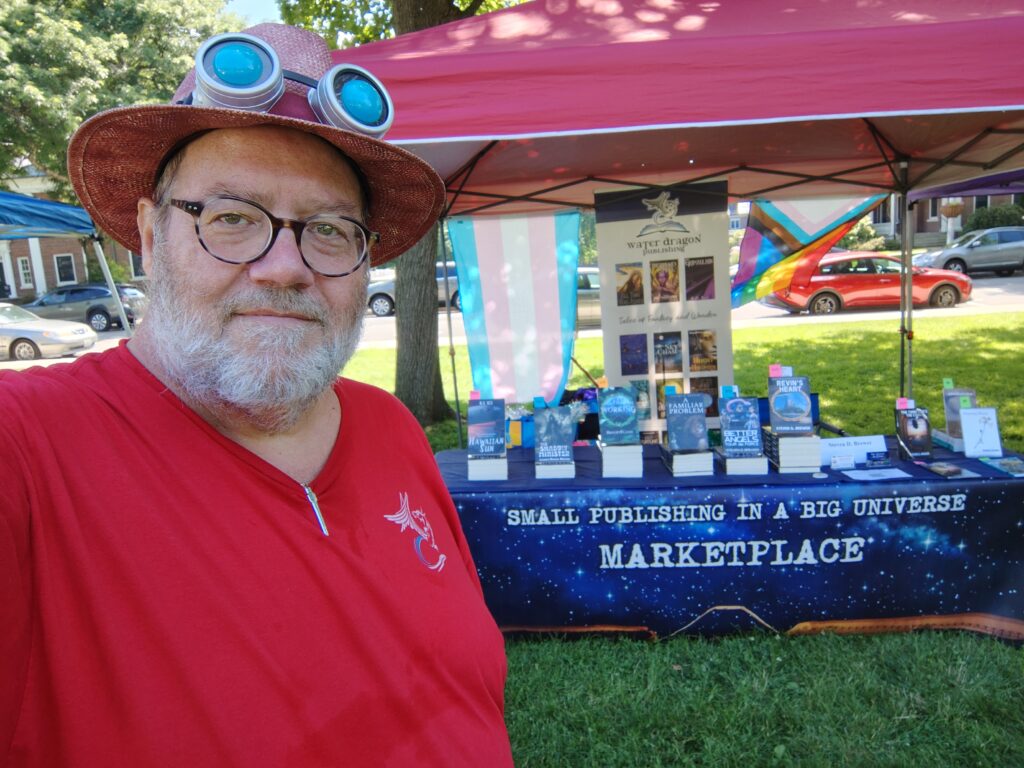
    an older man in front of a vendor tent

    Last year, I did both the Queer Artisan Market and Amherst Pride but, this year, I decided to just do Pride. Doing two days in a row is harder for me to handle now. In any event, the weather was perfect and, thanks to my experience last year, I knew where to site my vendor tent to be in the shade. I don’t think I sold quite as much as last year, but it wasn’t too bad.

    Fewer people are buying books. Partly, I think that people feel poorer than they did, so they just aren’t buying as many books. I’ve always noticed that most people simply don’t see books at all as they walk around. There are a few people who spot the books from a mile away and make a beeline to the table. But the ratio is shifting. There seem to be fewer and fewer people interested in books at all.

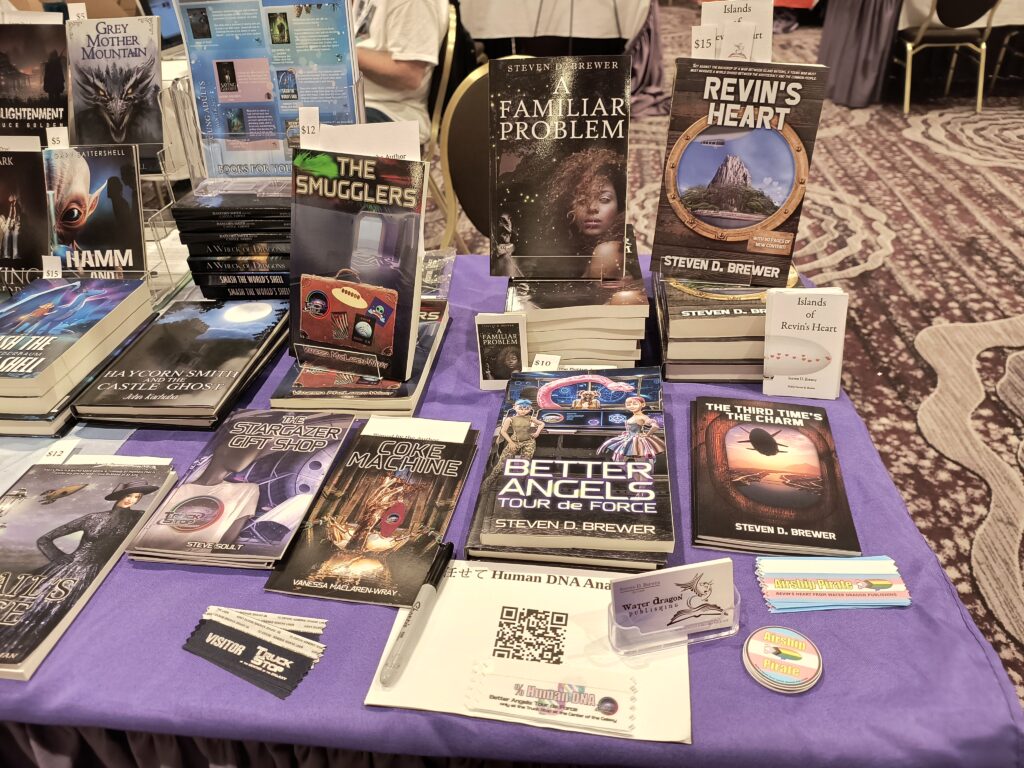
    It was my first chance to hone my pitch for A Familiar Problem. I got better at it. A lot of people like the premise. But I didn’t sell many copies. I did still some Revin’s Heart and Better Angels: Tour de Force. And a copy of Premitaj Floroj.

    I tried really hard to sell M.D. Neu’s book Hawaiian Sun. This seemed like a perfect book for Pride! It was a bit hard to pitch because it has a such weird premise. “So, there’s this guy on the Hindenberg who’s come to New Jersey to see his boyfriend, but then it catches fire and he’s like isekaied into the future where he goes on an airship over the Pacific Ocean to do some Pride stuff.” I pitched it over and over, but I don’t think I sold a single copy. Oh, well. Fail.

    Now, I’m exhausted and sunburned. But it was fun. Maybe I’ll do it again next year.

    → 6:30 PM, Jun 28
  • Review: The CIA Book Club

    coins

    I recently read The CIA Book Club: The secret mission to win the cold war with forbidden literature by Charlie English. It describes a covert program to fund underground publishers and cladestine efforts to provide access to information from the West to people behind the Iron Curtain. But is primarily focused on Poland.

    I had become aware of the CIA covert support for sending books behind the Iron Curtain years ago. A number of Esperanto books were published and shipped to Eastern Europe with money from the CIA. I picked up this book to learn more about the program, but I was a little disappointed when it turned out that the book is almost entirely about the effort in Poland in the 1980s.

    The events in Poland, from the coup in 1981 until the collapse of the communist regime in 1989, were at least minimally known to me. I graduated from high school in 1981 and I remember seeing reports on the television news about Poland. At that time, however — as a callow youth — I was not particularly paying attention to international or political events.

    The book focuses on the events principally following Mirosław Chojecki, an independent publisher. He had been publishing an anti-government newsletter and was imprisoned shortly after the coup. After engaging in a hunger strike, he was released and subsequently went into exile in the West. In the United States, he became aware of the CIA efforts, met a number of important political figures, and was brought into contact with the agent who was running the largest part of the operation with respect to Poland.

    The contributions of many of the other members of the underground publishing movement are also recognized: Helena Łucywos and the other women who published Wazovia Weekly, Jerzy Giedroyc — who ran the CIA front in Paris — and many many others. The book ends with the fall of the Berlin Wall and the dismantling of the CIA book operation. But it never really talks about any of the other parts of the operation, since it’s really just about Poland.

    It was an interesting read for me. Since I was only vaguely aware of these important events, it was nice to have a primer that provided a lot of the back story. But I would still like to know more about the CIA book program in general — and not just the parts related to Poland.

    → 9:32 PM, Jun 20
  • Review: Palace of Deception

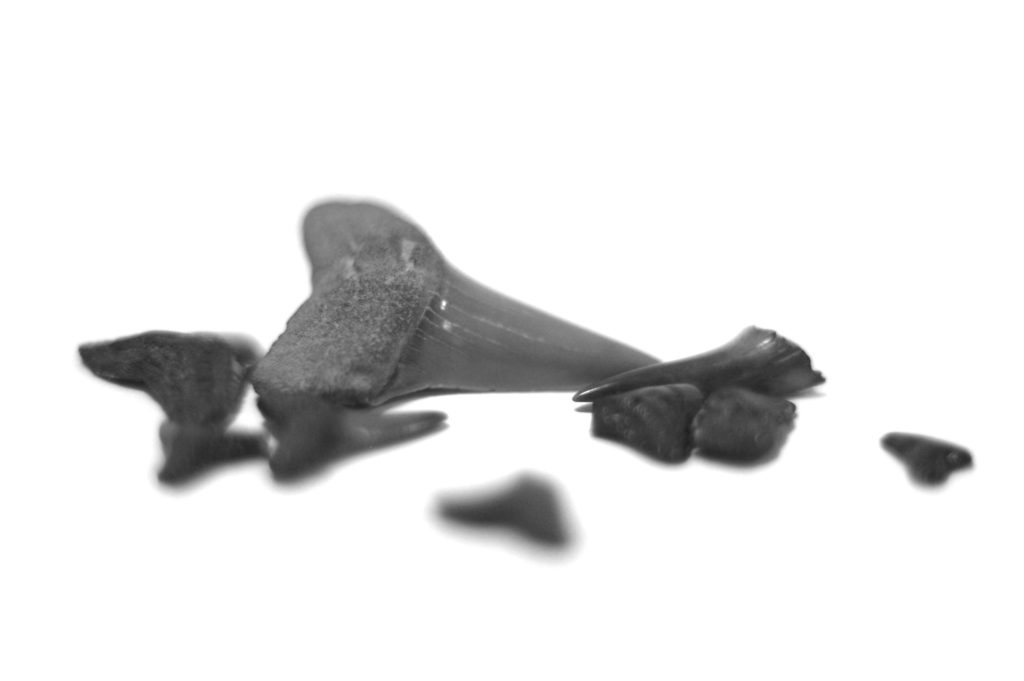
    fossil sharks teeth

    Palace of Deception by Darrin Lunde describes the lives of three men, Henry Fairfield Osborn, Roy Chapman Andrews, and William Akeley, who were instrumental in the creation of the American Museum of Natural History (AMNH). The book seeks to marry and intertwine what are really four separate stories into a coherent narrative. Each of the stories was interesting: but I felt the whole didn’t quite do justice to any of the stories.

    I’ve always been a fan of Roy Chapman Andrews. I first learned of him as a graduate student when I attending a workshop at Beloit College. Chapman grew up in Beloit, graduated from Beloit College, and became an adventurer who was, in many ways, the inspiration for Indiana Jones. When I saw this book that aimed to describe his amazing stories of adventure, I was hooked.

    The AMNH was actually founded by Albert Bickmore, who had trained with Louis Agassiz, with money raised from wealthy New York robber barons. But it was under Osborn that the AMNH grew and took shape as an institution.

    Osborn was a follower of Francis Galton, the cousin of Charles Darwin. Galton was a statistician who extended the thinking of Darwin to create eugenics and social Darwinism. Osborn — not unlike racists today — became convinced that immigrants were endangering the “superior” race, and he began to use the museum to propagandize this theory. He was also suspicious of laboratory science, and preferred the term “naturalist” for people who were studying the natural world. He hired both Roy Chapman Andrews and William Akeley as part of his plan to develop the museum.

    Roy Chapman Andrews, unlike Indiana Jones, was primarily a field biologist. He wanted to document and collect specimens of animals in regions of the world that had not yet been studied by Western science. He was successful at raising money for long expeditions to Asia (Japan, Korea, China, and Mongolia) that collected animals, and later fossils, to bring back to the AMNH. His exploits were extraordinary and the book touches on a number of them.

    William Akeley was a taxidermist. He developed a number of innovative techniques to create elaborate dioramas that showed animals in their natural setting and also went on long expeditions, principally to Africa, to collect big game (elephants, lions, and gorillas). Many people believed that Africa would be settled by white people, much as North America had been, and that all of the large animals would be driven to extinction.

    Each of the four stories, about the museum and these three men, is interesting in itself. There is a lot of fascinating detail, and the book does a good job of showing the complexity of the history around the subject. The book is also timely, given the current fascist push toward expelling immigrants and promulgating a racist “great replacement” theory.

    At the same time, the whole doesn’t quite hang together as a coherent story. The individual stories have the feeling of being incomplete as each has been subordinated to the overarching narrative. It’s still a good read, however.

    → 6:53 AM, Jun 12
  • Fantastic 2026 Worldbuilding/Worldbreaking Nebulas

    The 2026 Nebula Awards Conference was fantastic. I attended with my brother Phil. I had driven in a few days ago and spent several days with him before we traveled together to the conference. At the conference, I had only minimal obligations so I could spend most of my time attending the programming and hanging out with Phil. It was equal parts relaxing, interesting, and inspiring. It makes me want to get home so I can start spending more time writing.

    O'hare Crowne Plaza hotel

    The conference was held in the O’hare Crowne Plaza in Rosemont, near Chicago. The hotel was comfortable. There were a lot of stairs, but ramps had been constructed to allow bypassing them in a number of places. There wasn’t really any comfortable place to hang out outdoors at the hotel, which was a little annoying to me since I need to take my meals outdoors to unmask to eat. Phil and I found a “garden patio” which, although it didn’t have any seating, did have a small section of halfwall where we could sit to eat. There was also an “entertainment district” only 0.3 miles away with a bunch of restaurants with outdoor seating. We visited several times. Crust Brewing, a brewpub had really good thin crust pizza and Fat Rosies served excellent margaritas. There were several other places that looked amazing too. But it was a little too far away to get there and back between program events, so we could only go there a few times.

    On Wednesday, I spent the entire day attending a SFWA Board Retreat and Meeting. I spent the entire day taking careful notes of the meeting. I never fail to be impressed by the insight and varied perspectives that our board members bring to the issues. I can confidently say that it’s the best board I’ve ever served on.

    On Thursday, the conference proper began and I attended two panels and served on a third. Historical Perspective: the Evolving world in SFF brought Joe Haldeman and Jonathan Brazee, moderated by Dean Wells to discuss the phases of development of speculative fiction. Anthony Eichenlaub moderated a panel with Greg Kasavin, a Nebula finalist to discuss the role of worldbuilding and story in creating engaging games. Finally, I served on an Ask the SFWA Board panel where we introduced ourselves to the membership and let people ask us questions.

    On Thursday evening, we attended a reception to recognize volunteers. The president called up each volunteer to receive a surferticket and gave people an opportunity to make a brief statement. She asked me to say something that people didn’t know about me, so I said, “Mi parolas Esperanton.” A guy heard me and found me after the reception to talk about Esperanto. He’d started learning and was excited to hear I had some books of Esperanto haiku in the book service.

    On Friday, I attended three panels. The first was about diverse sexuality in worldbuilding for speculative romance with Cecilia Tan and Somto Ihezue, moderated by Jennifer R. Povey. Then Ben Francisco, Michael Solis, Charlie Jane Anders and Gabrielle Byrne talked about creating characters that are outsiders. An interesting distinction that they made was between characters that are new outsiders: still trying to understand how and why they don’t fit in, versus old outsiders, who are only too aware of the rules and made have developed strategies to conceal themselves or pass. A particular treat was a reading of speculative short plays with Alex Kingsley, Mary Robinette Kowal, Russell Davis, Jordan Kurella, Curtis Chen, and David Levine. These were amazing and a lot of fun.

    The Grandmaster this year was NK Jemisin who had an hour and a half slot to offer a crash course in creating compelling characters. Instead of presenting, she simply used the entire period for Q&A. I’ll admit was a little disappointed at first to not have a presentation, but SFWA members ask great questions and her responses were insightful and interesting.

    In the evening, I got to help with a reception for the Nebula finalists. Each finalist was invited to walk down a purple carpet to receive a certificate, get photographed, and then receive a pin from one of the Board members. In this way, everyone could recognize who the finalists were for the rest of the event.

    Steven D. Brewer and Anthony Eichenlaub at the Nebulas Autographing event

    After the Nebula finalist reception, there was an autographing event with a few VIPs and a bunch of the rest of us. I was seated between Anthony Eichenlaub and Somto Ihezue. I brought some giveaways and a few people took zines, ribbons, and stickers. One brave person ran the Makasete DNA Analysis Tool to fill out their percent human DNA for a ribbon.

    A few people even brought me books to sign! Philip bought a copy of A Familiar Problem and the guy who’d expressed interest in Esperanto the day earlier brought copies of Premitaj Floroj and senokulvitre. A bunch of people also brought their programs around and had everyone sign them. Jonathan Brazee, who was a Nebula finalist, brought his surferticket around for people to sign. My fountain pen got a good workout and I didn’t even squirt ink all over anyone.

    The next morning, Phil and I attended a presentation by Anthea Sharp about how to be successful on Kickstarter. A lot of authors (and even some of the pro markets) are using Kickstarter to raise funds for projects. She had a bunch of guidelines for how to run your first, small kickstarter. How much to ask for, how long to run it, setting reasonable targets. I took a lot of notes. I might consider using it for a small project just as a test run.

    We also attended a panel on speculative screenwriting for plays, comics, and audiodramas. I asked a question in this one: perhaps very basic, about how to structure scenes. I’ve never had any education about writing fiction: I’ve just read a lot of stuff. When I working to intersperse two timelines for The Ground Never Lies, I realized that I really wasn’t writing in scenes at all. I realized then that it was an obvious way I could probably punch up my writing a lot. Daryll Gregory answered my question and recommended a memo by David Mamet about how to heighten drama in scenes, which he shares on his website.

    Once again, I was scheduled to play a small role in the Nebula Ceremony as a “floor escort” to lead people to the stage at the appropriate moment for their speaking roles. They called this role a “runner” last year, which I commented that I was willing to try as long as hobbling around with my stick was close enough to running. So they changed the name this year. They ran a rehearsal that gave every speaker and finalist the opportunity to practice making their entrance and exit from the stage. Cat Rambo, a former SFWA president, commented that the team was really nailing down the details to make sure the show would come off smoothly.

    In the last evening, Philip and I dressed in our finery to attend nebula awards reception, banquet, and ceremony. At the reception, we mingled a little. Charlie Jane Anders noticed my airship pirate ribbon and, with unconcealed excitement, said she wanted one. I had left a few on the giveaways table, so I grabbed one and a sticker for her.

    Phil and I separated when we entered the banquet and I was seated with members of the board. The servers were running a bit late with the food and I had only just been given my plate when I was summoned to start acting as a floor escort. I stuffed a couple of bites of food in my mouth and then was up hobbling around with my stick escorting people to the stage.

    The ceremony was fantastic. Tananarive Due did a fabulous job as Toastmaster to warm up the crowd and serve as the master of ceremonies. NK Jemisin’s speech was really outstanding. I encourage everyone to watch it. It starts about 30 minutes in. Many of the other presentations are also excellent. SFWA people can write really well — as one might expect. People are generally overwhelmed when they win, which is charming to see. The ceremony ran for three hours. By the end, I was exhausted and went went straight to bed.

    Phil and I departed early the next morning. We’d had a rough time with traffic driving in, so we slipped away right after breakfast to beat the rush. I’ll spend another day here with him and then start my long drive back to Massachusetts.

    It was great to see everyone and I look forward to next year in Seattle. But I don’t think I’ll be driving to that one.

    → 6:59 PM, Jun 7
  • Writing Diversions

    a group of dice

    Since January, I’ve a lot of extra Tanuki Time, but I haven’t had the focus to work on my longer fiction. I have several projects that are essentially completed, but it’s beginning to look like I’ll need to find a different outlet for publishing them. While I’ve had less focus, I’ve been working more on shorter fiction.

    What’s For Breakfast, Toasterella is about a wizard who patented a method for contracting with sprites to compel them to work for you, but he discovers a limitation when he needs to change the contract. It’s been rejected twice.

    A Persistent Curse is about a dog caught between his owner and his witch grandmother regarding a particularly nasty curse. It’s also been rejected twice.

    Exit Interview is my newest complete short story. It’s what happens when the entities that are running the simulation your universe is in decide to shut it down. It’s been rejected once.

    Jimmy and Coral is a work in progress that’s not actually speculative fiction. It began as a series of vignettes posted to Wandering Shop Stories but, now that I’ve figured out the rest of the story, I’m just writing the rest in a document. It’s about a young woman whose mother is kidnapped and has to turn to her estranged father to try to get her back.

    Now that the semester is over — and once I’m through the Nebulas — I’m hoping I’ll have time to get back to the business of writing. I plan to start querying to look for a new publisher — or maybe self-publish my current book projects. I also have made arrangements to use a recording studio to try to create an audio book for Revin’s Heart. I’ve had a lot of interest in have an audio book available, so I’ll see whether I can do a good enough job myself. It will be fun to try.

    → 9:59 AM, Jun 1
  • Enroute to the 2026 Nebulas

    As May ends, I am enroute to the Nebula Awards Conference in Chicago. I am currently rusticating with my brother for a few days before we head up to Chicago on Tuesday. It should be a fun time.

    I had originally planned to travel with my son too, by driving. Trapping him in a car to drive is a nice way to have long conversations, which we rarely seem to be able to do under normal circumstances. But this year, he had plans to attend another event and it didn’t work for us to travel together.

    I like driving. I just wrote a post about taking the bus to avoid driving, but — in fact — being out on the open road is a pleasure for me. I really enjoy the feeling of flow: of having just enough engagement to keep me occupied, but not so much that I can’t let my mind wander and think about stuff.

    It takes two pretty long days to drive here, but it’s a drive I’ve made many times before and it’s interesting to see the changes that have taken place over thirty years. Each time is a little different. This year, I took the northern route along the New York Thruway.

    Gas prices were not as high as I might have feared. The highest prices I saw (in New York) were $4.78. The most I paid was $4.57. Prices were generally around $4.50, except in Indiana, where they have suspended the gasoline tax and the sales tax. I saw it for $3.82 at one place, and it was generally around $4.00. But it went right back up once I crossed the state line into Illinois.

    Speaking of Indiana, I drove through the largest construction area I’ve ever seen in my life near Lebanon. It was an area that almost defies comprehension: 10,000 acres, or 16 square miles. It was immense. Evidently, Indiana has created a special regulatory/tax district called LEAP (Limitless Exploration/Advanced Pace) that is basically a scheme to enrich the extremely wealthy. The wealthy are incredibly happy to be enriched, so they’ve taken advantage of this opportunity and they seem to be building at least two gigantic projects, a $4.5 billion project for an Eli Lily “Medicine Foundry” and $10 Billion for a Meta data center.

    I saw a lot of other interesting stuff on the way. There’s a place near Erie, Pennsylvania that has billboards for Big Woodie’s Fireworks. They sell not only fireworks but pepper spray, tasers, and swords. Nothing like enjoying fireworks with a nice squirt of pepper spray! Hoof Hearted Brewing sounded like place worth visiting: weird brews and weird artwork. I saw a car that had a bumper sticker that said “Serene Transportation” that was zipping frenetically in-and-out of traffic. And no trip would be complete without a stop at the Uranus Fudge Factory, which has to be the best name for a confectioner ever. “The best fudge comes from Uranus!”

    Anyway, for two days, I can rest and visit with my brother in Champaign. We don’t have any particular plans, other than to write, take walks, and maybe drink some beer. It’s nice to visit with family.

    → 9:14 PM, May 31
  • Getting Back on the Bus

    PVTA bus in Amherst

    Today, I started riding public transportation again. Amherst has a great bus system provided by the Pioneer Valley Transit Authority (PVTA). When we first moved to the Pioneer Valley, I lived for two years in Pelham — one of the “hill towns” that surround the valley. During those two years, I had to purchase an expensive parking sticker and drive to work. As a newcomer, the only parking stickers I could get were a long way from my office. I initially selected the closest lot I could find but when I asked my colleague he said, “Do you want to die? That’s on top of Orchard Hill. In the winter, you will slip, fall, and die trying to get down the hill.” So, I picked a lot that was essentially as far as you could get from my office and still be on campus.

    When we purchased our house, it was about the same distance as that parking lot had been. But, even better, there was a bus stop at the corner of our property. It took about 15 minutes to walk to my office but, if I timed it just right, I could take the bus and get from my front door to my office door in under three minutes. It was so efficient, it made it kind of hard to walk. If I did walk, two or three buses would go past. Eventually, when I did want to walk for some reason, I started walking a slightly longer route that took me along a different street where I didn’t have to have it rubbed in my face that I could have ridden the bus.

    During the pandemic, I pretty much quit riding the bus. Even before the pandemic, I had started my Professional Improvement Fellowship and was going to the Makerspace, instead of my office. The Makerspace was even closer than my office and not on a bus route, so I just walked to that. And once the pandemic started, I wasn’t going to my office anyway. And then I was hospitalized and needed to avoid respiratory infections, so I started working remotely.

    Looking back, I also realize now that, even before I was hospitalized, I was already showing symptom of chronic lung disease. It became harder and harder to walk any distance. It was a very gradual process that I explained to myself by saying I was “out of shape” or that I’d gained some weight. In fact, my lungs just weren’t working very well and I was constantly suffering from hypoxia. Doctors would ask me if I suffered from “shortness of breath” but I literally didn’t understand what that meant. Since I had been suffering from shortness of breath for so long, it just seemed like my natural state. A respiratory therapist I worked with in the hospital said, “Wow. That must have been really hard.” I felt seen.

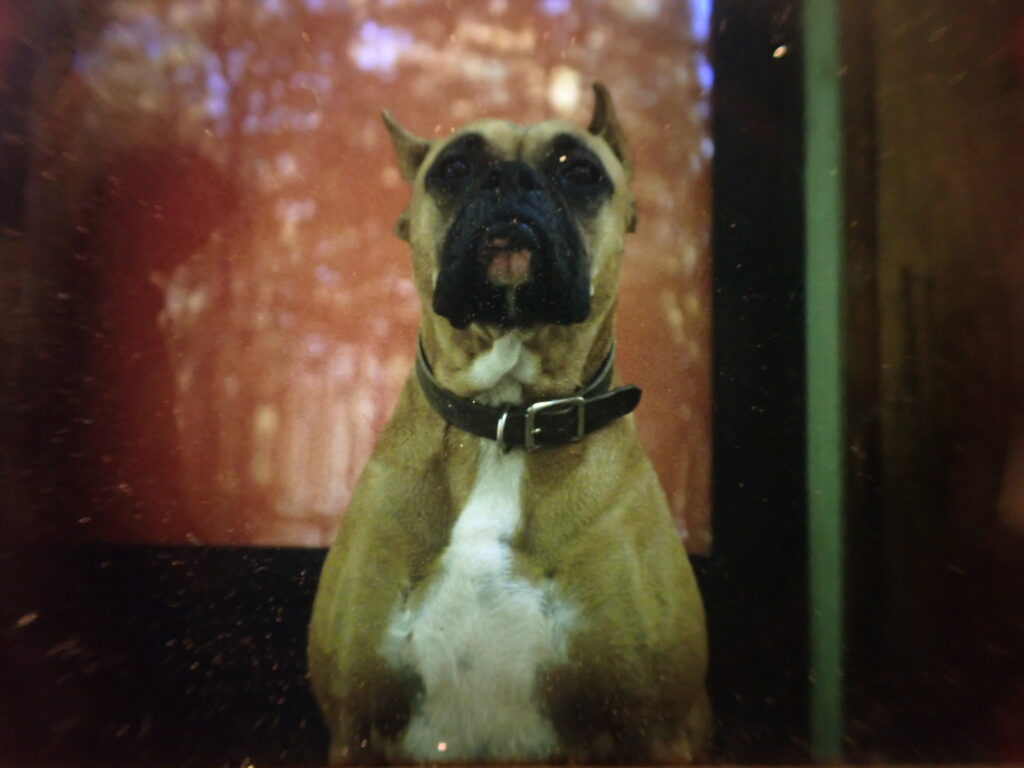
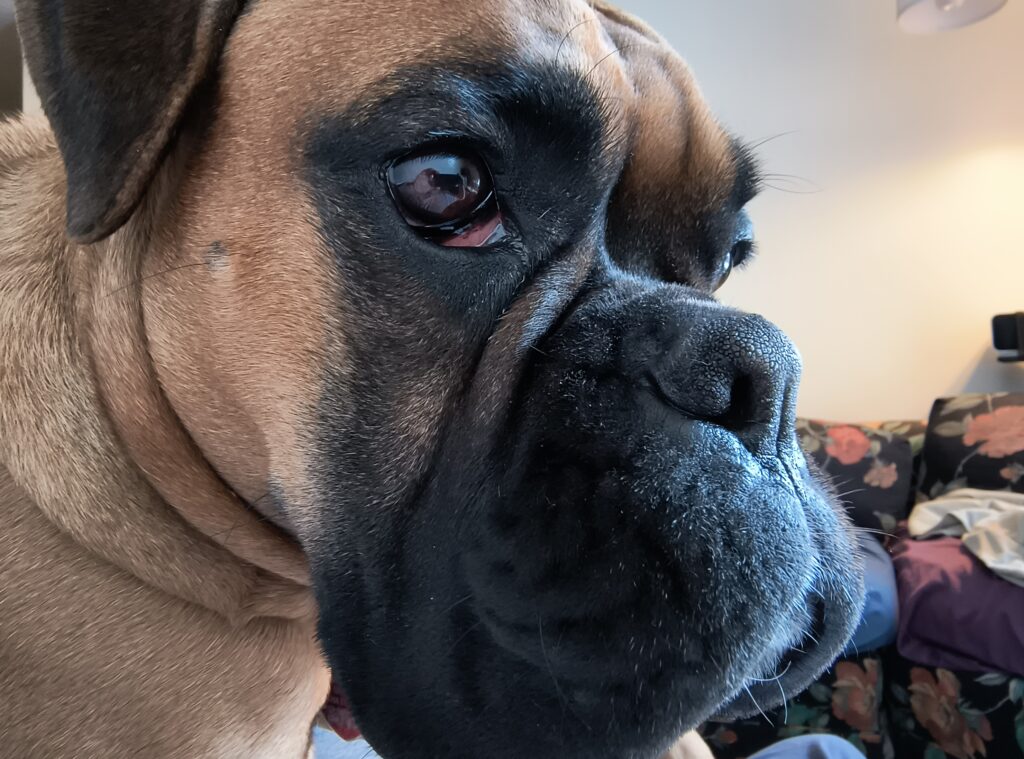
    Although I didn’t need to go to an office anymore, I did take daily trips to visit and check on my son. This was particularly true after his hospitalization this winter. Since then, I’ve visited often twice a day to support him and take care of his boxer dog. While the students are in town, the buses tend to be very crowded through campus, so I decided to drive. And I didn’t think much of these trips until gas prices began to spike after our mad king’s unconstitutional war against Iran. Today, with the students gone for the summer, I decided to mask up and start taking the bus again.

    It was fun to refamiliarize myself with the practices of riding the bus. The bus tracker website, that you can use to see when buses will arrive at the stop. The various bus routes and their vagaries. The unwritten conventions, like the fact that you don’t have to signal for stops at some places, like the middle of campus or Cowles Lane (my destination). And that you do have to signal for the stop nearest my house, but that you should wait to signal until you get past the previous intersection. (Over the quarter century I rode the bus, I learned that if you signaled too soon, the bus driver would occasionally forget and blow right through the stop. I saw that happen a handful of times when people signaled too soon, but never if you waited to signal.)

    I was also reminded of the slower, more relaxed, pace of life the bus imposes. When you drive, you can stay busy right up until you leave. Then you’re busy driving. Then you arrive right at your destination. With the bus, you have a short walk to the bus stop, a brief wait until the bus arrives, a relaxing ride, and then you arrive at a short remove from your destination and have to walk a few steps to get there. It’s relaxing — and it fits well with my new-found freedom as a retired person.

    Next fall, when the students come back, I might start driving again. But, for now, I’m having fun.

    → 11:09 AM, May 19
  • Review: The History of Money

    Money

    The History of Money by David McWilliams (2024) is subtitled “A story of humanity.” It skims over a vast landscape, dipping in now and again for a deeper dive into moments when innovations in how societies created and managed money (or failed to do so) contributed to world-changing events. The complexity of our current world economy has grown up guided and constrained by the cautionary lessons of history, but ever spurred on by people’s greed and prurient interests. This book provides an enjoyable and useful introduction with a lot of fascinating details along the way.

    He begins with the earliest known examples of commercial tallies, records of values, and transactions, going back to the stone age. The theme of money shifting between measures of commodities (e.g. grain or precious metals) or value (as anchored by fiat and monetary policy) plays out over and over throughout the book.

    Many important historical figures are introduced with the roles they played in advancing innovations in monetary practice and policy. I’ve always lamented that, as someone in the sciences, I had little flexibility to study history and classic literature. McWilliams has prompted me to consider reading at least two important books out of history: Xenophon’s Oeconomicus, the foundational text of economics and Liber Abaci by Fibonacci.

    The books ends with a pretty harsh dismissal of cryptocurrencies:

    Over the years we have seen that money is a technology designed to solve a problem. I’m scratching my head as to what problem Bitcoin in particular and crypto in general actually solve. Despite the small foothold Bitcoin has gained in the mainstream US investment market, crypto looks set to remain on the fringes, a source of obsession for its supporters and aficionados, but not very useful or practical in reality. Bitcoin is to money what Esperanto is to language.

    Other than the slur against Esperanto, I am in complete agreement. I mean, he’s not actually wrong about Esperanto either, but I would have preferred he slander Volapük rather than Esperanto to make his point.

    If you’re curious about understanding how money works in practice and how it came to be the way it is, this book is a great place to start.

    → 1:11 PM, May 18
  • Retiring to… Something

    an old railroad pocket watch

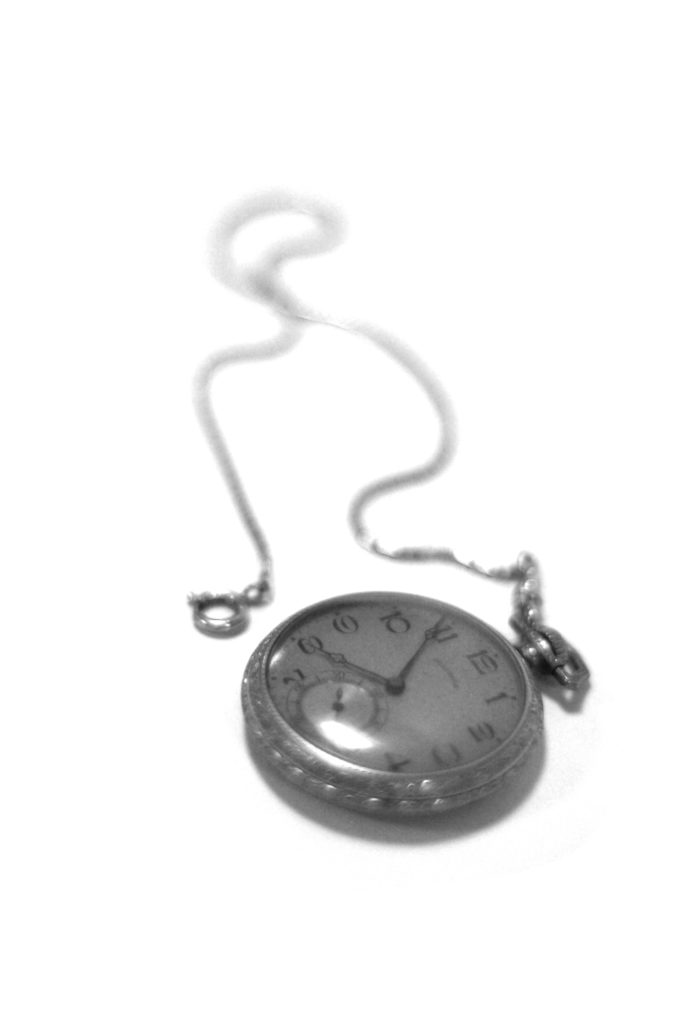
    Two years ago, I began a phased retirement. Last Thursday, I conducted a University class meeting for the last time, presided over my final Faculty Senate meeting, and (by coincidence) also celebrated my 38th wedding anniversary. And today — Tuesday — is special because, on my Tuesday/Thursday teaching schedule, I would have been teaching today. (I mean, I wouldn’t have because it’s finals week so class wouldn’t have met anyway, but you get the idea).

    My brother, who retired fifteen years ago, recently had a piece of advice for me.

    The weeks leading up to retirement, and the weeks after retirement, are particularly nice. Do savor them. Don’t just let them slip by as if they were ordinary weeks.

    I’ve been trying to take this to heart.

    Although we agree about many things, we sometimes actually come at things from quite different perspectives. He never really wanted to work and pursued a career with the goal of retiring early. I, on the other hand, aimed to find a career that gave meaning to my life and represented what I would have wanted to be doing anyway. I tried to embody the aphorism, “Do what you love and you’ll never work a day in your life.” I am not a spiritual person, but I believe in the sanctity of work.

    I decided to dedicate myself to science education. As an edutainer, I had visited hundreds of elementary-school classrooms and had seen how few teachers understood what science really was: Not merely a collection of facts, but a way of knowing and apprehending the world. I believed that improving science education was a potential way to help people make better, more-informed choices about the environment.

    When the Internet happened, I was given a front-row seat to helping faculty transform education using technology. For a brief moment, I was in a position to show people how technology could be used, not merely to reproduce the existing paradigm, but to create new environments to foster learning.

    The work felt important to me. It seemed like work worth doing. I could make a case to myself that it was worth dedicating my life to the task.

    In part, I was motivated by Journey to Ixtlan. It’s a rather silly book. But I read it as a young man and certain themes appealed to me. In particular, the notion that, since death may arrive unpredictably, you should aim to use what time you have intentionally.

    This was reinforced for me when I had a cancer scare in graduate school. A barber spotted a questionable mole on my ear and recommended I get it looked at. I made an appointment with the campus health service and a physician’s assistant inspected it. She studied it, pulled out an illustrated guide, studied it some more, paged through the guide, and then finally announced, “I think you’re OK because it looks like this one.”

    I said, “You’re pointing at a picture that’s labeled ‘Deadly Melanoma.'” It was. It was literally labeled “Deadly Melanoma.”

    She paled. “Oh. Oh! Oh… Let me me go get the dermatologist.”

    They took a biopsy and, a week later, the results came back. It was not malignant. They still recommended getting it removed, so I scheduled the surgery. But a week of having that in the back of my mind was rather… focusing.

    Similarly, my decision to retire was significantly influenced by my hospitalization when I was diagnosed with a chronic lung condition. This made working and teaching seem a lot less fun. And got me thinking that I had better things to do than keep beating my head against a wall.

    As I’ve approached the end of my phased retirement, I’ve attended several workshops where people talk about retirement. One person suggested that, rather than “retiring from” one should aim to “retire to”. For a lot of people, this is perhaps a useful distinction, although it was never really in question for me. If I wasn’t doing work, I would be doing something else creative. I have no shortage of interesting projects I intend to work on in retirement.

    I have plenty of things to work on. I have several fiction writing projects. I have several books in progress and a lot of short fiction that I should be shopping around to publishers. I have wanted to make a new book of haiku for a couple of years and just thought of an idea for an accompanying art project that might be fun to work on. There are also some gardening projects that might be fun to try. I would also have fun doing some technology projects again as well. And, of course, there are also my service commitments to SFWA and Straw Dog. There is plenty to keep me busy.

    After my two years of phased retirement, I still have several months to savor as I approach full retirement. This week, I’ll get the grading completed for my last class. Since I’m on a nine-month appointment, the summer is a period of “non-responsibility” (or irresponsibility, as my brother likes to joke.) So, although I’ll still be formally employed, I won’t have any more official duties. I can attend a few Rules Committee meetings and join them to meet with the Campus Leadership Council. And August 31 will be my last day. I will have been a faculty member for 30 years and one month.

    It’s enough.

    → 5:24 PM, May 12
  • Watching the Rain on Watch City… from Home

    Today, I was scheduled to attend the Watch City Steampunk Festival to sell books. But it wasn’t to be. After several days uneasily watching the forecast, this morning I checked the radar and made the final decision to cancel my appearance. It was a “perfect storm” due not only to the rain, but also a shortened festival and higher travel costs.

    I was planning to bring a small selection of new books. I was ready with copies of A Familiar Problem, M.D. Neu’s Hawaiian Sun, and Lawrence Rafael Brother’s The Shadow Minister. I was also planning to bring Brightstar’s The Working (which had been released last year, but was out-of-stock during Watch City) and, finally, my own backlist including Revin’s Heart and Better Angels: Tour de Force.

    Rain means death for book sales. Books themselves are particularly vulnerable to rain. Perhaps the only thing worse to try to sell in the rain would be cotton candy. Or maybe owls. Any books you put out for display are likely to get water damaged and become unsellable: nobody wants to buy books that have gotten wet. Moreover, the wet ground also makes it difficult to even protect the stock you don’t put out. And, of course, it suppresses attendance which also reduces sales. Furthermore, rain also often brings wind, which knocks over books, scatters promotional giveaways, and can even blow over the tent.

    Last year it also rained. But last year, the rain was predicted to wrap up around the start of the festival. Although we got wet during setup, the festival itself was mostly dry (though cold and pretty miserable). This year, the rain is just getting started and it looks like it will only get heavier as the day wears on. There’s even a chance of thunderstorms during load-out.

    In addition, this year the organizers were compelled to shorten the length of the festival. The town passed a new ordinance that events on the Common may only run for four hours. I suspect a lot of vendors were already planning to skip the event due to the difficulty of justifying the costs of attendance with the shortened time frame of the festival.

    Finally, of course, gasoline prices are a lot higher this year. The trip represents about four hours of highway driving, which costs almost twice as much due to the mad king’s unconstitutional war against Iran.

    As I wrote in my bookselling post at Planetside and on my blog, even in the best of circumstances, you’re doing well if you make back your table fee at these kinds of promotional festival events. It’s rare you actually come out in the black when you consider travel and other costs — to say nothing of labor. It wasn’t going to happen this year. As my mother says, “There are times when you just have to give up on things.” But at least I’m warm and dry.

    → 7:46 AM, May 9
  • Straw Dog Writers Guild 2026 Spring Retreat

    a selfie showing some participants of the Straw Dog Writers Guild retreat participants

    On April 25, 2026, the leadership of the Straw Dog Writers Guild gathered at the WOW Creative Arts Center in Westfield for a day-long retreat to discuss the organization. Fifteen people — the entire Steering Committee plus a handful of others — spent the day getting to know each other and the organization a bit better. By the end of the day, all of the world’s problems had been solved. Well, maybe not all of them. But we did have a productive conversation.

    Due to my chronic health condition, I wore a mask for the event. It appears to me that respiratory illness is not particularly high right now, but I normally avoid spending long periods of time indoors with groups of unmasked people. I really don’t want to end up in the hospital again. The last time I attended an indoor Straw Dog retreat, I had persuaded the participants to mask for my benefit. But it was controversial and unpopular with some people, so I didn’t try to do that this time.

    In the interests of full disclosure, I should point out that the post that follows is not a comprehensive report of what happened at the meeting. I did not take sufficiently detailed notes to represent everything that everyone said. This over-represents what I said and offers reactions primarily from my own perspective.

    We began with an ice breaker. Becky Jones called on each of us to identify some symbol or metaphor to define ourselves. I broke the ice by saying what I typically say in such circumstances. Other people had similarly whimsical perspectives about themselves.

    Ellie Meeropol provided a sheet with a summary of Straw Dog Writers Guild accomplishments from 2025 and 2026. For 2025, there were around ten on-going regular activities (Writer’s Night Out, Straw Dog Writes, Second Sunday readings, etc.) and around twenty one-time events (workshops on the craft and business of writing, Author’s Showcase, etc.) and this looks on track to be similar. It was impressive to see all of our work represented.

    a diagram showing straw dog activities, committees, and how they're organized.

    Jacquelyn Sheehan and Bill Mailer led a discussion to flesh out a diagram (click to see full size) listing all of the on-going activities. We began with just trying to catalog everything then show how they map into committees and standing bodies. Finally, participants were invited to initial the parts they are involved with. I’m listed for Straw Dog Writes, the Program Committee, and website. I’m currently scheduled to chair a committee to coordinate with Christopher J. Sparks and Electropoetics, that will start redesigning the Straw Dog website in the coming months.

    Don Lesser brought forward a question of whether Straw Dog should charge non-members to participate in workshops. This generated a lot of discussion that included a consideration of Straw Dog’s mission and the history of this topic, which was tried before and rejected. Making non-members pay a nominal fee to attend both has the potential to get people to see more value in the workshops and actually show up, if they’ve registered. It also might give members an increased sense of value for their membership. It also could suppress participation and raised concerns about its alignment with Straw Dog’s mission. My primary contribution to the discussion was about practical concerns: It sounds simple, but would require a fair amount of staff support to build out the infrastructure to collect the money, track which registrations were by members, check attendees for payment, integrate with online registration systems, etc.

    During the potluck lunch, I stayed inside without eating because I avoid unmasking indoors. The last time I attended a Straw Dog retreat, I took my lunch outside and ate by myself. But I found that rather stigmatizing because everyone else was having conversations that I was excluded from. (I had persuaded people to mask that time, but they all necessarily unmasked during lunch and I didn’t feel safe staying indoors.) So this time, I just didn’t eat and talked with people while they ate. This was also stigmatizing (as if being the only person wearing a mask wasn’t stigmatizing in itself). But it was OK and I had some nice side conversations with people.

    After lunch, we did another community building activity where we interviewed another person and then reported a summary of the conversation to the group. I met a young woman named Emily whom I hadn’t met before. At least I don’t think I’d met her before. I summarized the blog post I was writing about work and she talked about how her conception of location or place had evolved as she transitioned from childhood to adulthood. It was charming to get to know her a little better —and to learn a bit more about all of the other participants from their reported conversations.

    Julie Schlack and Mary Ann Scognamiglio led the final activity of the day, to brainstorm ideas to aid recruitment and retention of new members. There were a lot ideas about building and sustaining community. I had been spending the day making notes of ideas that I had, which I then shared with the group. My ideas were:

    • Recruit member representatives for local organizations in the communities we serve to facilitate communication and ensure our activities are made visible on event schedules, bulletin boards, etc.
    • Develop a recruitment presentation that members could use to describe Straw Dog to other audiences.
    • Bring some focus to a national recruitment campaign (as our workshops are increasingly available via zoom, we’ve already picked up a substantial number of members across the country, which we could grow.)
    • Offer support and coordination for book launches to members. (We have a virtual book launch coming up that we’re hoping to use as a template.)
    • More committees or advisory boards for program elements, to provide increased opportunities to members to grow into leadership positions in the organization. (We have only a small number of actual committees currently, but it was pointed out that the WriteAngles conference could always use more volunteers.)
    • Set up book vending machines to sell books for members. This is an idea I’ve seen be successful in other areas. It would require some capital, but I think a lot of authors would jump at the chance to have their books available via vending machines it the machines would serve as advertising for Straw Dog and its authors.
    • Offer more articles via the website and coordinate with the newsletter. Offer posts about writing, about members, about events, and maybe book reviews. Have teasers in the Newsletter and use it to drive more traffic to the website.
    • Use communication software more effectively. Currently most Straw Dog communications occur via email which has a lot of downsides. Committees mostly communicate by people just using “reply-all” to the last message sent to the group, which has the potential to miss some people, propagate typos in email address, or include the wrong people (if someone was copied into a previous message). We could use Discord or a threaded-discussion system (or someone recommended Slack) to communicate more effectively. This would ensure the history of groups remains accessible so that interested members or newcomers could lurk and more easily get up to speed..
    • Use our CRM more effectively. We have a new CRM, but it could track more information about members and our previous contacts with them, so that we can target subpopulations and follow up with people better.

    There were a number of other ideas as well, but those are the ones that I brought forward.

    At the end, Bob Plasse, the President of the Board of Directors of WOW was given an opportunity to comment on our retreat and tell us more about the WOW Center. He had a lot of insight into a community organization like ours and described what WOW was doing that we could consider replicating or articulating with.

    The retreat was time well spent and I’m hopeful that we can implement a number of the ideas in the coming year.

    → 3:32 PM, Apr 26
  • The Sanctity of Work

    an istvan bierfaristo mug

    After reading Riva’s Escape (a side story of Revin’s Heart), one of my beta readers commented about how they appreciated the way my writing recognized the value and significance of work. In the scene, Revin (who has just transitioned) is pressed into service working in the kitchen of a restaurant washing dishes. This got me thinking about how my own experience with work has impacted how I write about it.

    I started working on a farm before I was legally old enough to work. At age 15, a friend and I were hired to bale straw. We rode on a wagon behind a tractor grabbing bales of straw that emerged from the baler — a complicated machine that was powered by a shaft from the tractor. We would take turns carrying the bales back and stacking them up until the wagon was full. It was hot, dirty, and dusty. Looking back, my current lung condition probably wasn’t helped by breathing all the dust. We would often work until it was starting to get dark. I remember coming home in the gathering dark, taking a shower with the sluicing off me, closing my eyes, and feeling like I was still bumping along on the wagon. Years later, I tried bailing hay. As an adult, I was hired to work by myself on the wagon (ie, working twice as hard) and lifting bales that weighed twice as much. I lasted one day.

    I spent two summers as a high school student working as an animal caretaker in a toxicology laboratory. It was a bleak, proletarian existence. You were required to punch a time clock within seven minutes (five minutes before the hour or two minutes after) to punch in, then punch out before legally required breaks and lunch, punch back in afterwards, and then punch out at the end of the day. I was on the “large animal” team that cared primarily for beagles. Other teams did mice, rats, rabbits, and monkeys. The entire windowless facility had tan walls, gray floors, and unfinished ceilings with black-painted duct-work, pipes, and wiring. The animal rooms had two banks of stacked cages with a big floor sink at the end. I would go into a room, clean and fill all the water dishes, then pull the trays under the cages one after another, wash them in the sink, then replace them. Finally, I would recheck the water dishes and clean/refill any that were empty. (Some dogs, desperate for stimulation, would dig in their water dish as soon as you filled it.) It became so routine that I could daydream during the process to the extent that, when I got my schedule out after leaving a room, I sometimes had to check to see if I had just finished a room or just arrived.

    I worked for a year as a busboy at chain seafood restaurant. There, I had perhaps the worst boss I ever had as an employee. In the restaurant, there was a lounge attached to the restaurant with an entrance for patrons and a passage containing the busboy station near the ice and soft drink dispensers for waitstaff. The boss would walk through those entrances in a big circle and every time she came around, I was doing the wrong thing. “Why are you bussing tables! The floor is dirty! Sweep the floor!” So I’d carry my tub to the dishwasher, get the sweeper and start sweeping the floor and she would return, “Why are you sweeping the floor! There are tables that need to be bussed!” She was pure evil.

    I worked for a while as a gas-station attendant. When I was in middle-school, they had kids take the “differential aptitude test” — one of the many standardized tests used for nefarious purposes by educators — that included a component that was supposed to help you identify potential career options. I knew that I wanted to be a field biologist, so I tried to pick options that I thought would be aligned with that goal: Yes, I liked working outside. Yes, I liked working with numbers, etc, etc. Eventually, the computer spat out an answer: it said I should be a gas-station attendant. So, when I actually worked as one years later it was a more than a little ironic. I actually liked it quite a bit, though it was not a particularly good choice as a career, with poor pay and limited options for advancement.

    I had a lot of different jobs over the years. I was a dishwasher in a college cafeteria. I worked as an archeological faunal analyst. I was a Spanish-speaking bilingual teacher’s aide for a migrant worker education program. I was a substitute teacher for a time. (That was horrible.) I did scientific field work in many different contexts: catching birds, lizards, mongooses, etc. For several years, I was an “edutainer” traveling to elementary schools to teach about science. I visited hundreds of schools in a dozen different states.

    Eventually, I returned to graduate school. I pursued a PhD in Science Education. (I also got a Masters in Earth Science studying wetlands hydrology). While I was doctoral student, I got tasked with setting up a computer lab and then the Internet happened. These experiences led directly to my career as a faculty member serving as the Director of a computer center at an R1 institution. In this role, I performed a vast number of teaching, research, and service activities. (My curriculum vitae is more than 20 pages long.)

    These work experiences have all informed my writing in multiple contexts.

    I find that “work” is actually a somewhat loaded and conflicted word. On the one hand, it can mean the drudgery you are required to perform. But it can also have the connotation of your calling, your “life’s work,” which for many people becomes nearly their identity. Some people detest work while others strive for the ideal of “do what you love and you’ll never work a day in your life.” I have deep respect for the work that people do in all walks of life. And I was pleased that this was reflected in my writing to the extent that someone noticed it.

    → 8:10 PM, Apr 25
  • Bartholomew’s Cobble: Mosses and Lichens and Ferns! Oh, my!

    a rocky outcrop covered with mosses, ferns, and lichens

    Relatively soon after I moved to the Pioneer Valley, my father gifted me a membership to the Trustees of Reservations and encouraged me to visit Bartholomew’s Cobble. It’s a bit of drive, in the extreme south-west corner of the state. But it’s an amazing place with the highest plant diversity of any site in New England. This spring, I visited again to see the spring wildflowers.

    A friend and I made a road trip out of the adventure. We masked up (due to my health issues) and drove on back roads so we could keep the windows down. We drove first to Westfield and stopped at Skyline Trading Company for lunch. Then we took a new (to me) route through the back roads, criss-crossing over the Connecticut border to get there.

    I’ve always been fascinated by plants. As a child, I frequently went with my father to natural areas where he introduced me to plant identification. As an undergraduate, I took a lot of botany classes: plant morphology and structure, spring flora, and plant systematics. And, as a graduate student, I studied wetlands hydrology, for which plant identification was essential.

    Bartholomew’s Cobble is a promontory of quartzite and marble situated by a bend of the Housatonic river. This creates four distinct zones: cool dry, cool wet, warm wet, and warm dry. Plus the marble limestone, relatively rare in Massachusetts, creates regions with higher pH which adds to the range of available microhabitats. This produces the high plant diversity at the site.

    We arrived in mid afternoon and, after paying the admission fee, set out walking. There are several trails through the reservation, but the one I always take is the half-mile Ledges trail. It simply follows a route around the promontory and takes you through each of the habitats. You start at the cool-dry quadrant, then pass into the cool-wet segment along the river, then turn west into the warm-wet, then warm-dry, and then finally return to the parking area.

    a rocky outcrop with wake robins and dutchman's breeches underneath.

    The progression of spring wildflowers was markedly different between the cool and warm sides. In the cooler areas, spring had only just started to arrive. There weren’t many flowers or fiddleheads. But mosses, lichens, and older growth were apparent. The warmer sides had many of the classic early spring wildflowers: triliums, dutchman’s breeches, trout lilies, spring beauties, etc., etc. It was lovely.

    My friend is a molecular biologist who was intrigued by the variety of plants. Like me, he teaches the writing class at the University. He was fascinated by the number and variety of plants and began thinking about adapting his version of the course to have students look at plant diversity in the fall. It’s a lot easier than it used to be.

    I spent years and years studying plant identification. Nowadays, I find that although I can still recognize a lot of familiar plants, there are vastly more I never learned. I even wrote a haiku (published in Ideoj Ĝermas) about the experience of seeing the plants that bloom after your spring flora class is over.

    Also identifications have changed. A lot of the nomenclature I learned has been replaced, as molecular systematics has reorganized the phylogeny of plants.

    Nowadays, you don’t need to learn plant identification at all. People can use apps to identify plants. I’ve used LeafSnap and, more recently, iNaturalist, that also keeps a record of plants you’ve observed and has experts that help confirm identifications. This can allow students — even with little experience with plant diversity — to make observations about plant species and distribution.

    I’ve visited Bartholomew’s Cobble perhaps five times over the past thirty years. Maybe someday, I’ll walk some of the other trails.

    → 11:30 AM, Apr 23
  • When the United States Actually Jumped the Shark

    old jelly jar

    After Donald Trump was elected for a second time, he began to systematically destroy the “rules-based order” that the US had painstaking constructed after World War II. It’s elements included having an independent bureaucracy and judiciary, floating the dollar as the reserve currency of the world, keeping the world’s communications networks centered here, maintaining an enormous military to be the world’s policemen, etc. Although somewhat expensive, this arrangement provided enormous benefits.

    In little more than a year, these are all in tatters. The US is now the largest and most powerful corrupt mafia state in the world, run entirely at the whim of a single dictator who maintains a masked paramilitary force to terrorize cities, who arbitrarily attacks dairy farms and fishing boats, who abducts the leaders of other countries, and who unilaterally begins wars.

    People argue whether he is the cause or the symptom of an electorate that is too stupid and provincial to understand what immense harm he’s doing to the standing of the country. But I would like to argue that the moment that the US actually jumped the shark and began on the path that led inevitably to this moment was when Ronald Reagan was elected.

    I think this graph pretty much sums it up:

    Post by @Lightfighter@infosec.exchange
    View on Mastodon

    Ronald Reagan had a handful of bad ideas and pursued them vigorously. He began the process of undermining confidence in the ability of government to be a force for good. He began the Republican practice of appointing cronies to govern incompetently and cynically, so that people would see government negatively.

    Critically, he presided over the decoupling of productivity gains from wages for workers. The voodoo economics of “trickle down” began under Reagan. Prior to his administration, as productivity increases, wages for workers increased commensurately. After Reagan, productivity continued to increase, but wages were flat. And basically have been flat until today. The rich got richer, but everyone else got poorer and poorer.

    These two factors are what we see playing out today. People no longer believe that government or expertise are forces for good. Even though they enjoy the fruits of science, technology, and medicine, they have been impoverished economically, and they blame government.

    To be fair, the Democrats have not distinguished themselves. Under Bill Clinton, the Democratic party became a kind of Republican-lite. He creating the Democratic Leadership Council that began pursuing funding from the wealthiest in the country. Democrats pushed back against the worst excesses of the Republicans, seeking at least to govern competently, but remained in the pockets of the wealthy and failed to effectively advocate for working people.

    I could see these things happening when Reagan was President. I kept waiting for the country to realize the enormous damage had done. But they kept naming things after him, as if he had done anything other than preside over the destruction of the American dream. Now, finally, people seem to be realizing the enormity of the injury he inflicted on the country. But the damage is done and things are likely to get worse for a long time to come at this point.

    Donald Trump has made the United States an international pariah. The rules-based order isn’t coming back. The rest of the world is never going to trust the United States again. So the country is likely to get poorer for for the foreseeable future. Sorry. I mean the population of the United States. The billionaires will probably keep getting richer.

    Donald Trump is the one who actually took an axe to the world order that had been so painstaking constructed to benefit us. But the seeds its destruction were sown by Ronald Reagan. And we are left to reap the bitter harvest of his cynical crop.

    → 9:44 PM, Apr 4
  • In the Spotlight

    Steven D. BREWER

    On March 29, I was spotlighted by J. Scott Coatsworth. Scott is the creator of Liminal Fiction and QueerSciFi. On his blog, he runs a series of articles that let authors respond to a range of potential questions to highlight their recent work. I answered questions about my first published work, weird things I’ve done for research, secondary characters in A Familiar Problem, my favorite character to write, fonts, writing without dialog, what I wanted to be when I grew up, pets, what I like to drink, whether I’m afraid of snakes or spiders, and what I’m working on now. I also provided a synopsis of A Familiar Problem a brief excerpt.

    I’m never sure how useful it is to do these kinds of things. I don’t know how often they lead to sales or get people to learn more about me as an author. But I’m not really sure that’s the point. It was fun to answer the questions and give me an excuse to link to Scott’s blog.

    → 4:40 PM, Mar 31
  • A Reflection on No Kings and Revin’s Heart

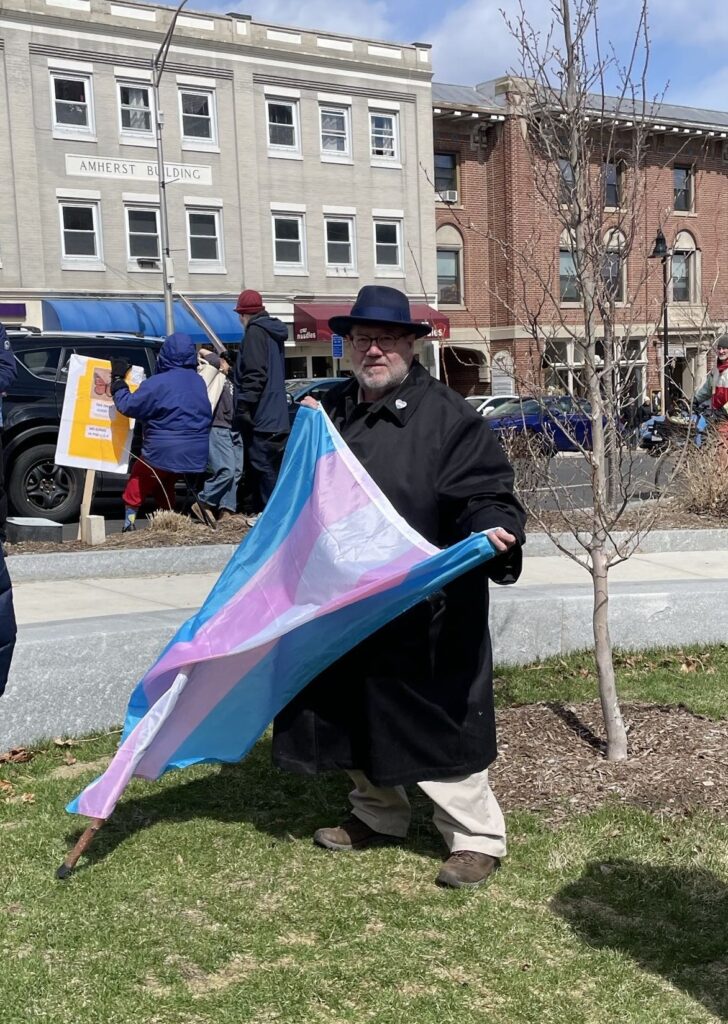
    an older man wearing a trenchcoat and blue fedora is holding a trans flag at the Amherst No Kings protest.

    I took a trans flag to the March 28, 2026 No Kings protest in Amherst. There are many things to protest about Trump and the MAGA movement: the misguided war in Iran, the destruction of our global alliances, the endless grifting and profiteering. To me their persecution of the trans community has been among their most odious acts. During the first Trump administration, I recognized that the Republicans were organizing to use trans people as a wedge to divide the country. And this was a motivating force behind my fiction writing.

    My debut work was Revin’s Heart, a steampunky fantasy adventure with pirates and airships and a trans protagonist. Part of my goal in writing about trans people was because I was moved by their struggle. It’s monstrous that the Republicans have identified a small minority of people to demonize in order to foster division in our society. Letting trans people live their best lives costs them nothing. Yet, they attack and demonize them in a sadistic and self-serving effort to pander to the worst instincts of hateful people. We must stand united in the face of this hatred.

    In point of fact, Revin’s Heart is barely about trans issues at all. It’s just a young man’s adventure story, where the young man happens to be trans. He has some experiences that are unique to his identity as a trans person, but — for the most part — it’s just a young man making friends, finding mentors, confronting challenges, and living his best life.

    Where Revin’s Heart becomes a critique of our society, is when it talks about feudalism. During the first Trump administration, I was horrified as he anointed his children with government roles — exactly as a monarch would do — and the Republicans did not revolt. This kind of behavior would never have been accepted in the country I grew up in. Neither would the constant mendacity, self-dealing, or corruption. I saw that there was a striving on the Right for someone to be a king and for people to want to be vassals. So I wrote about a society corrupted by these principals and tried to identify both the strengths and weaknesses — and show someone trying to look beyond to what might be possible instead.

    I have written three novella-length sequels to Revin’s Heart that continue this conversation. In the first, Revin must confront a revanchist movement that has taken hold on his home island of Devishire. In the second, he works to quell a populist uprising in the town of Campshire that threatens to provoke the worst impulses of the aristocracy. The third, takes place on a foreign island, Ecorozire, that has been devastated by civil war and social collapse. I hope to be able to share these stories with the public soon.

    Back in Amherst, I had considered making a sign for the protest, but decided that carrying the flag was the most eloquent statement I could make. I saw a few other rainbow flags and signs advocating for trans issues. A few people didn’t know what the flag represented and asked me. Several trans people approached me to thank me for bringing the flag and a few asked if they could be photographed holding one side of the flag. It made me feel good to help them feel represented.

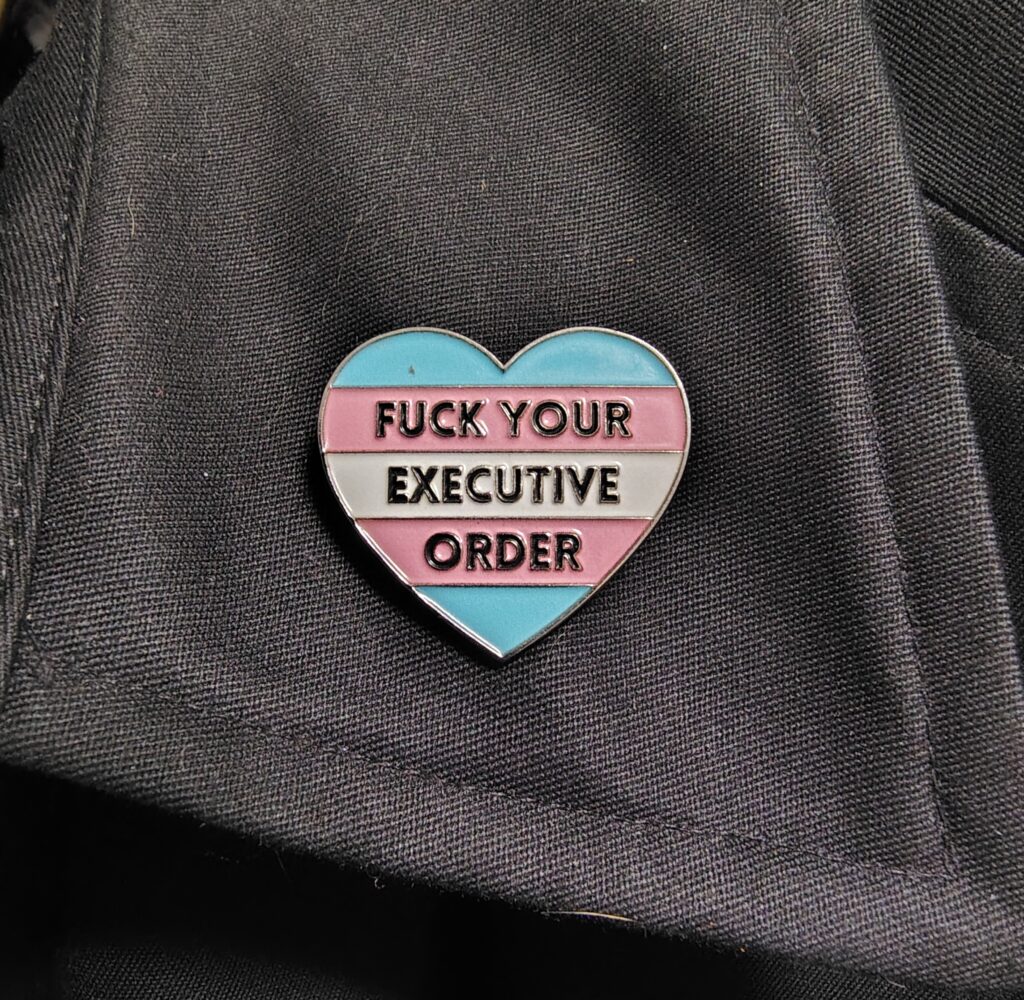
    a heart-shaped pin with trans-flag colors that says,

    I wore one other small symbol at the protest: a pin that was gifted to me by Oliver Jensen. Among the flurry of executive orders that the Trump administration issued at the very beginning of his term were a number that were targeted at persecuting trans people. Oliver designed this pin and had several produced which he gifted to people on Mastodon. I requested two: one for myself and one for a trans colleague.

    When I first got the pin, I wore it on a daily basis for months. I was proud to wear it again for the protest. Oliver has since moved to Germany, but he said that he was honored and grateful that I wore it to the protest to represent him.

    The energy at the protest was generally positive. People are angry and horrified by the terrible actions the administration is taking, but they take encouragement from one another. Awful things are happening, but we can support one another and have faith that things can get better. Amherst is a blue, blue drop in a blue lake. We here are largely sheltered from the worst of what is happening in the country. The Commonwealth of Massachusetts is standing up to the worst excesses of the Trump administration. We have not been invaded and assaulted by the masked Brownshirts of the Trump administration. We can protest without fear of being clubbed and beaten by jackbooted thugs. For now. Let us hope for better days for all.

    → 9:48 AM, Mar 29
  • Using a Text Editor for Writing

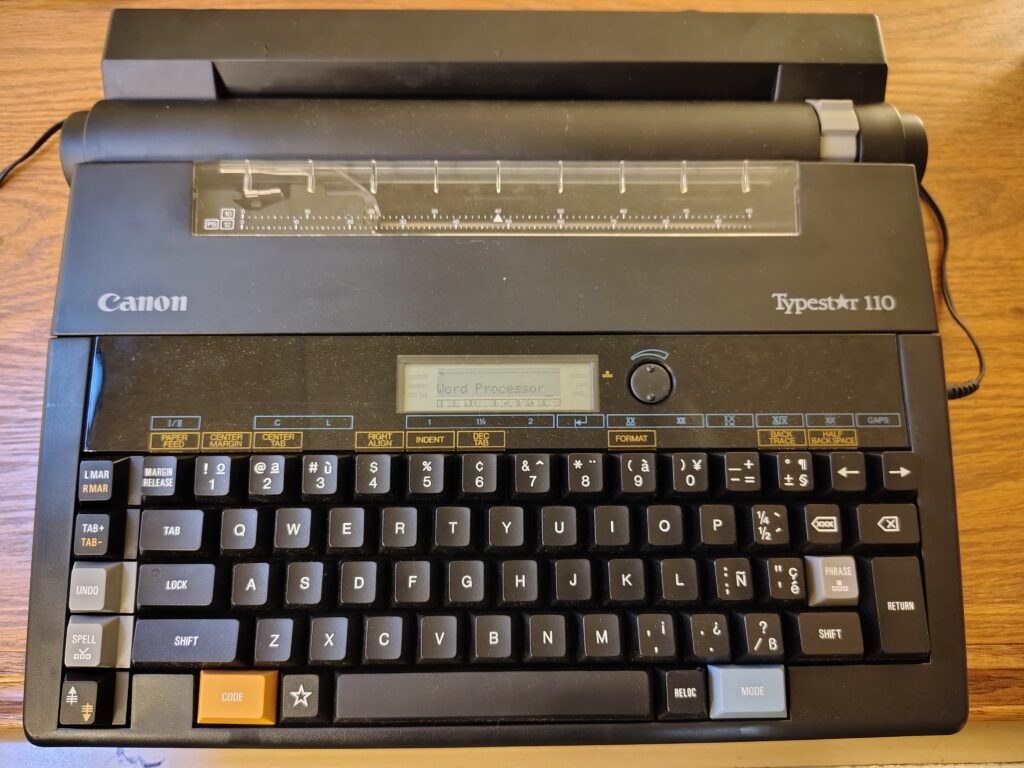
    odd typewriter word processor hybrid manufactured by Canon in the early 1980s. It has a lcd display where someone has typed

    I use a text editor for pretty much all of my draft writing. I can date this pretty much to 1993, when Microsoft Word 6.0 was released. It really sucked and, after many years of using a word processor, I quit using one for writing.

    I did most of my early writing by hand or using a typewriter. I took “secretarial typing” in high school — they changed the name that year to “business typing” which was perceived as less sexist. I was the only boy in the class. There was a “personal typing” class that required students to learn to type 45 words per minute. But in secretarial typing, you needed to learn touch typing (to not look at the keyboard) and type 60 words per minute. It was perhaps the single most useful class I ever took in my life.

    I also learned to use DEC computers with a paper terminal in high school. Mostly, I was programming in BASIC. There was rather crude text editing, but I could see the potential for writing text. There was a text formatting program called RUNOFF that I experimented with a little bit, but it was too complicated for my purposes and so I never actually used it for anything. But I could see the potential.

    When I went to college, my family purchased a Smith Corona electric typewriter for me as a gift for going to college.

    As an undergraduate, I learned to use a word processing system — maybe ALL-IN_1 — on the VAX computer at Alma College. It used a “gold key” to access formatting commands and you could do a lot of amazing things. I had been using my typewriter to write papers, but quickly switched to writing everything using the word processor.

    Around that time, a friend kept asking to borrow my typewriter. I didn’t mind since it wasn’t like I used it anymore: once you got used to using the word processor, the idea of going back to using a typewriter was a monstrous impossibility. I kept suggesting that he learn to use the word processor, but he always claimed to not have time. So I finally said I would type his paper for him using the word processor.

    There was a central terminal room, but we went to a small computer lab in the life science building. I logged in and quickly typed his paper. Then I printed it using the dot-matrix printer in the lab. He looked at it skeptically, then said, “Yeah. OK. But it has a widow.”

    “Let’s fix that,” I said. I typed a few keystrokes and printed again. When I handed him the output, his eyes got bigger and bigger and bigger.

    “You can print it again?” he breathed.

    He got an account the next morning.

    I had other computers along the way (including the odd typewriter/wordprocessor hybrid pictured above) but when I started graduate school, I bought a Powerbook 100 and a copy of Microsoft Word 5.1. It was amazing. It was perhaps the best word processing system I ever used. I used it to write all my papers as a graduate student, including my gigantic 200 page dissertation that had 88 figures and 15 tables.

    Then Word 6.0 came out and it was garbage. It was clunky and unstable. It frequently crashed and you lost what you’d been working on. Its documents frequently became corrupted and were unrecoverable. I kept using my old copy of Word for a while, but it was clear its days were numbered. So I switched to doing all of my draft writing using a text editor — so at least I wouldn’t lose my writing.

    On a Mac, the best GUI text editor for a long time was BBEdit. I used that for a number of years, then (when it quit being shareware) I switched to TextWrangler.

    Note: I’m leaving out the whole chapter where I learned Unix and the vi editor. I used vi a lot for programming, but there wasn’t a native vi for classic MacOS, so it wasn’t something that was convenient to use for local files until MacOS X came out. So, although I use vi a lot, I never used it much for writing.

    When I began teaching the writing class, at first I chose different packages for Macs and PCs. Then I started using Linux myself and started looking for applications that would work identically on all three platforms. Eventually, I settled on Atom, which was released in 2015 and I started using that.

    Atom was an adequate text editor. It was built on Electron, which made it a bit bloated and clunky. But it worked exactly the same on all three platforms. It was also highly configurable and had a lot of community add-ons to provide additional functionality.

    In 2018, Microslop purchased Github, and in 2022 killed off development of Atom — probably to force people to use their proprietary development environment. But, because Atom was Free Software, the developers promptly forked it and renamed it Pulsar. It works exactly like Atom did and I still use it today.

    I had very little success persuading students to use a text editor to write. And I didn’t see many other people using text editors either until this year. Suddenly EVERYONE seems to be using text editors to write. Weird. I guess everything old is new again.

    A bunch of people seem to be using Obsidian. Tobias Buckell described building a whole writing environment based on Obsidian. Other people are using Notion and NotebookLM and there are a bunch of others.

    I’ll keep using Pulsar, at least until I finish teaching the writing class. Then, maybe, I’ll look at others to see if I can find something I like better. But I’ll still want something that is Free Software and cross platform.

    → 2:54 PM, Mar 26
  • A Much Needed Spring Break

    crocuses

    When I was the Director of the Biology Computer Resource Center, Spring Break was just a chance to get caught up with software and hardware updates. Since then, I’ve used it to accomplish significant bits of writing. This year, however, I really needed the break. And I took full advantage.

    I used my time for self-care. I slept a lot. I got in a lot of walking. I hung out a friend on the patio. It took some time, but I finally started to feel like myself again.

    For the first time since December, I felt like I could write some fiction. I wrote a short story, A Persistent Curse, and submitted it for publication.

    With his paws on the back of the sofa, Makul poked his nose through the curtains and looked out. A misty drizzle was falling — it always rained when the curse was bad. The raindrops passed through an assemblage of shadowy spirits clustered just outside the window trying to get in. 

    Makul waited, watching, until she came around the corner: a short, wizened crone with a dowager’s hump who shuffled along with a stick to hold her up. She gathered her black shawl around her shoulders as she hobbled around the corner and into the shade from the lone cloud that hovered over the apartment building. Her mouth made a hard line when she looked at the building and saw the swarm of spirits jostling around the first-floor apartment of her grandson.

    “Tiom da fantomoj!” she muttered. “The curse is bad this morning.”

    It was rejected. But at least I feel like I have some creative energy again. It was a long dry spell.

    I’m still getting some extra Tanuki time. But little by little, things are returning to baseline.

    I remind myself that it’s my last Spring Break. This is my last semester as an active faculty member. I’m trying to be particularly cognizant of the milestones and rhythm of academic life as I experience them for the last time.

    In any event, today is the last day. Tomorrow, the students come back and on Tuesday I’ll start teaching again. I have a fair amount of grading I’ve been putting off — and my regular service commitments this week: Faculty Senate and Rules Committee.

    Once more unto the breach, dear friends!

    → 4:42 PM, Mar 22
  • Languages of Tsukimichi

    A graphic for Chapter 10 of Tsukimichi, 10th Night: Language Barrier, showing the protagonist reciting a tanka remembering his first encounter with a hyuman:
the first human
that I've met
in this other world
screamed
and ran away

    I read a chapter or two of a manga a couple of years ago and, at the time, it didn’t grab me enough to keep reading it. But my son wanted me to try an anime he liked and, after an episode, I realized it was the same one: Tsukimichi: Moonlit Fantasy. After watching a few episodes, I decided to read the manga, Tsuki ga Michibiku Isekai Douchuu. (I have not read the light novel, though it might be interesting to do so.)

    I mentioned to Philip that I was watching the anime. I said something like, “It’s an isekai about a guy who is dropped into a kind of wasteland. He makes some powerful allies and things just go pretty well for him.”

    “It sounds like slime,” he said, meaning That Time I Was Reincarnated as a Slime.

    “It is!” I said. “It’s exactly like slime! But completely different.”

    What I really want to write about, however, is how Tsukimichi manages representing different languages. I’m not sure I’ve ever seen a manga that tries to manage so many languages like this.

    The protagonist, Makoto, is picked up from Japan (where he spoke Japanese) and is sent to the other world where he meets with the “goddess” who is repulsed by his ugliness. She banishes him to the “edge of the world” but gives him “the ability to understand what demons, monsters, and other non-human races say”, but not to speak the “hyuman” language.

    The Edge of the World is a wasteland inhabited by powerful monsters where hyumans (people) rarely go. And, sure enough, he can seamlessly communicate with monsters and a girl orc that he encounters there. She is rather puzzled that a (seeming) hyuman can speak her language. When she teaches him magic, she apologizes that the chant “isn’t in orcish”. It’s represented in the manga with some weird script.

    The protagatonist reciting an incantation

    You don’t learn the background of what the script actually represents for another hundred chapters. But this is one of the ways that other languages are represented.

    When Makoto first encounters hyumans, their speech is represented in a different odd script and (as the goddess had said) he can’t understand them and they can’t understand him. (He writes a tanka about it — see the top graphic above and read the alt text for the translation of the tanka.)

    He subsequently discovers that basically everyone can speak a “common tongue” — except him. Even when he studies it, although he gets so that he can understand it, he can’t make himself understood by speaking. But he discovers he can generate written speech with magic that people can see and read.

    In this graphic, you can see the protagonist using the written speech that someone can see. But you can also see a speech balloon with a doubled line that is a horse (actually a kind of monster called a “bicorn” hiding its two horns) that is talking to him in a language that others can’t read, represented with the doubled line — what others can hear “buhii”. And then his thought balloon with the hashed outline.

    A little girl explains the common language to Makoto. She says its a blessing of the goddess that people receive after visiting a shrine. It makes it seem like she considers it something separate from just learning a language as a child. But her description makes it seem indistinguishable from just learning a language as a child. The demihumans, who lack the blessing of the goddess have to learn it in addition to their native language. But basically all of them seem to do so.

    As an aside, I would be interested to learn more about the common language. It seems like it could be Esperanto-like. But we really haven’t learned much about it at this point or why hyumans don’t have separate languages or even regional variation. In Japanese, of course, there are a lot of regional variants (e.g. Kansai and Osaka-ben).

    In the end, he needs to address most hyumans using magic writing. But he discovers an alchemist who can speak an “ancient language” (normally used for spellcasting) and can speak with them. He can also speak with demons and all of the demihumans, including bicorns (pictured above), werewolves, forest ogres, etc. There are a vast number of different kinds of demihumans.

    In addition to speech, some characters can use telepathy with the protagonist. This one is a bit complicated but represents the linguistic complexity being represented pretty well. Read top-to-bottom, right-to-left.

    First, the upper panel. The first statement, “They even had quite the fanbase in Tsige” is a telepathic communication by an interlocutor (not the person represented in the panel). The statements, “Aqua-san went to Rotgard?! Our Eris-sama!!” are comments made by those people in the common tongue, but recollections — not part of the current conversation. Makoto says, “And won’t fans be sad about their departure?” is a telepathic communication from him that is part of the conversation.

    In the lower panel, Eris (a demihuman forest ogre) is speaking the common tongue (which you can tell by the font), to which Makoto replies in the forest-ogre language. Then Makoto switches to using a new form of secure telepathy that Eris can’t eavesdrop on, which is identified by the thick black inner border.

    There are also a number of nods to Japanese. The only characters that can speak Japanese are Makoto and his contracted magical servants, that gain it through their connection with him — plus two other characters that were isekaied from Japan. One of his servants is a dragon who decided to contract with him after studying his memories and becoming fascinated with period dramas. She styles herself as a samurai and adopts various aspects of samurai dress and speech (using “washi” instead of “watashi” as a pronoun, for example.) Another older, more powerful dragon, is revealed to have lived with a previously isekaied person who has since passed away. They haven’t yet had that character speak Japanese, but I’m looking forward to it.

    It’s a charming story and I’ve enjoyed reading it so far. I’m looking forward to further releases as they become available.

    → 12:55 PM, Mar 20
  • When the Well is Dry

    Geyser

    Since December, I’ve basically not written any fiction. I’ve written a few blog posts and managed to keep up with my class — checking my students’ writing and making comments on their papers. But I’ve barely been able to write fiction.

    I learned long ago that my creative output is unpredictable. And I generally don’t really worry about it. I know that it will bounce back in time. But it’s still no less frustrating when I try to do some creative writing and the words just aren’t there.

    I did manage to write a haiku today. And tonight, I did got a few manuscripts that had been previously rejected back out to calls for submission.

    It’s been a discouraging year.

    I understand why so many people drop out of trying to get their work published. It’s easy to get depressed and lose hope when your work gets rejected over and over and over again. But this is not my first rodeo.

    I know that at some point, the words will come. And, like a geyser, they’ll come pouring forth so fast I’ll be hard pressed to get them down as they come spraying out.

    Until then, I just need to hang on.

    → 9:45 PM, Mar 10
  • War, by any other name, still stinks

    pepper box

    Like most, I was astonished when my country performed an unprovoked military attack on another country. My initial reaction was to note that every journalist had pulled out a thesaurus to look for synonyms for “war” because in the United States, according to the constitution, only Congress could declare war and no such declaration was made.

    Since then, I’ve watched with horror as my country assassinated the leaders of the other country and committed war crimes by attacking water supplies and sinking unarmed naval vessels. It’s appalling.

    I was hopeful that Congress might actually develop a spine and reign in the brutal madness of this administration. But no such luck.

    As I said on Mastodon, I am anti war, but not just anti war:

    Post by @stevendbrewer@wandering.shop
    View on Mastodon

    The Iranian regime has been a disaster for the region since the United States destabilized the democratically elected government in 1953. The puppet government the CIA installed oppressed and tortured people and precipitated the Iran revolution. The fundamentalist Islamic government took over the US embassy, oppressed women and minorities, and has worked to destabilize the entire region, funding militia groups and supporting terrorism.

    Personally, I think it’s most likely that destabilizing Iran will prove to be disastrous. At best, we’ll end up with a strongman bent on revenge. At worst, a failed state with warring groups that align with different regional powers where fighting spills out across the entire region.

    Another likely possibility is that we get someone who says the things that Trump wants to hear. Some people might take that as evidence that Trump’s intervention was “successful.” I think that’s not the right lesson.

    Trump is good at getting people to say things that aren’t true. This sometimes make it seem like he’s being more successful than he actually is. Getting people to say something is one thing, but what they actually do when they’re seething, is likely quite different. But we won’t see the effects of that immediately.

    The other related thing is that we don’t have any journalists anymore. So, irrespective of the facts on the ground, we may well only see reporting that gives the impression his intervention was successful.

    I still think that’s the least likely scenario. Far more likely is that we’ve bought ourselves another “forever” war and it will take a generation to extricate ourselves from trying to provide security for the region. And, in the meantime, we’ve dramatically increased the value of the oil that both the US and Russia produce. That’s probably what this is really all about in the first place.

    → 9:09 PM, Mar 7
  • Oni Diras Nun! A Tabloid for Esperantujo

    an image of Källë Kniivilä, Tutmonda Ĵurnalisto, photoshopped in front of some building — in England, if I recall correctly — wearing a Carmen Miranda hat with a weasel riding a woodpecker on top.

    In 2007, when I was still engaged with US Esperanto movement, I decided that what it needed was a tabloid newspaper to share fantastical stories about Esperanto personalities and events. I persuaded a couple of people to help (mostly Philip Brewer and Robert Read) and we produced a one-off newsletter — printed appropriately on tabloid paper — to hand out at the Landa Kongreso in Tijuana. We did it a few more times — in 2009 and 2013. I don’t know that it ever gave anyone more than a chuckle. But we had fun doing it.

    I called it Oni Diras Nun! (or ODN for short.) This translates roughly as “one is saying now” but an onidiro is a rumor, so it has a tongue-in-cheek meaning more like “current rumors”. I hacked together a logo that shows the face of a prominent Esperanto journalist speaking into the ear of Zamenhof (the creator of Esperanto).

    I hacked together a website for it. Eventually, however, the website quit working. Recently, I saw something that reminded me of it (an artist, Jason Chou is photoshopping Paddington Bear into everything imaginable. In ODN, I photoshopped a picture of a friend into a whole variety of unlikely places.) So I decided to take a few minutes to at least post a page that recovered the links to the PDFs of the issues — which never really left the Internet. So, for everyone (Anyone? Anyone?) who’s interested, here is OniDirasNun!

    Highlights include:

    • The face of Zamenhof on toasted bread — but unfortunately the face of Felix Zamenhof, which limited its potential value.
    • The presidents of Esperanto associations who form a committee to consider the possibility of doing something.
    • A local Esperanto group success story from Champaign, Illinois.
    • An article about a memorial toilet seat where a local Esperanto group has met.
    • “Are Language Rats Human Rats?” (In Esperanto the words for “rats” and “rights” look similar).
    • The largest Esperanto library that you can never visit (the NSA’s archive of intercepted communications.)
    • Källë Kniivilä Worldwide Journalist (pictures showing an Esperanto journalist photoshopped into various fantastical locales).

    We did have one more issue planned that was going to include La Ligo de Esperantaj Senmortuloj — an imaginary league of immortal Esperantists who had gone by various names over the century of Esperanto’s existence. But I got busy and my enthusiasm for Esperanto waned, so that issue never saw the light of day.

    → 2:09 PM, Feb 28
  • Hash-browned Potatoes

    A russet potato and grater.

    I’ve always loved hash browns. It’s perhaps my favorite way to eat potatoes. I don’t really like mashed potatoes (though they’re edible with enough gravy). And, as far as I’m concerned, you can discard the potato part of a baked potato because I really only like the skin. But hash-browned potatoes are special.

    I tried making them a few times years ago and failed pretty utterly. Then I discovered a boxed brand of dehydrated potatoes that worked OK. They weren’t great, but it was better than nothing. Then the grocery store quit carrying that brand. So I broke down and actually looked at some recipes for hash browns. Using those, with several rounds of experimentation, I’ve developed a set of heuristics that works pretty well for making hash browns the way I like them.

    Grating a hemispherical band around the potato.
    Grating around the potato.
    Grating along the long axis of the potato.
    Grating along the long axis.
    Rinsing the grater and filling the bowl of grated potatoes with water.
    Rinsing the grater and filling the bowl.

    I’ve tried several varieties of potatoes and found that russets seem to the best for hash browns. The others have a tendency to become mushy. Nobody likes mushy hash browns.

    I have this ancient grater that works, but requires a few tricks. I start by grating all around the potato, to make a band around the potato. Then I rotate the potato and grate along the longest edge, periodically switching which direction I’m grating to grate the potato evenly. This gives nice long strips of potato. Eventually, I turn the potato on its end and grate it down to a tiny bit of skin.

    Note that I include the skin in my hash browns. Some weirdos might like to peel the potato before grating it, but for me the skin is the best part.

    Once the potato is grated, I fill the bowl with water (which is a convenient way to rise the rinse the grater. Then I add a fair amount of salt to the water. I probably should measure how much salt I use sometime. I’m not sure it really matters all that much. Most of the salt is lost when you drain the potatoes. But I think increasing the osmolarity of the water causes the potatoes to lose water, which makes them taste better.

    Grated potatoes spread out in a cast iron skillet.
    Spreading out the potatoes.
    Hash browned potatoes with melted cheese on top.
    Melting cheese on top after turning.

    Once the potatoes are soaking, I pour a bit of canola oil into the cast iron skillet and start heating it up. I use medium heat (6/10 on my dial). As the skillet heats up, I drain the potatoes into a colander. Once the oil is hot, I spread the potatoes out in the skillet.

    I let them cook until they’re brown on one side (5-10 minutes) then flip them over, usually in two portions. Rather than timing, I tend to cook them until I see and smell that they’re browning. Probably actually timing things would be better, but I’m not that kind of cook.

    I usually like to melt some cheese on my hash browns. I sometimes joke that this is how I make my vegan hash browns non-vegan. There are other ways you could make them non vegan: e.g. use butter or bacon grease instead of canola oil. Or make breakfast stew.

    Maggot's Breakfast Spew: a plate of hashbrowns with scrambled eggs, sausage, and bacon.

    A restaurant in Southwest Michigan I used to frequent in graduate school made a dish called “Maggie’s Breakfast Stew” which is easy to make at this point. Rather than adding cheese, just throw in some diced sausage, bacon bits, and two eggs, then scramble. I think they also added onions and green peppers, but I think it makes the dish a little wet. You can add cheese at the end too. Or not. It’s not going to be vegan either way.

    I used to call it “Maggot’s Breakfast Spew” because it’s not a very pretty dish. I imagined they kept these giant caterpillars in the kitchen that would eat the ingredients and then they would squeeze them out into the pan to cook the dish. I have a very vivid imagination.

    Maggie’s is also where I learned to make a so-called Mexican omelet, but that’s a recipe for another day.

    Anyway, that’s how I make hash browns. Enjoy!

    → 11:06 AM, Feb 22
  • The Language Game: AI Edition

    NPR headline: ChatGPT promised to help her find her soulmate. Then it betrayed her

    I find it intensely annoying when people ascribe intelligence, or intentionality, to statements by AIs (i.e. Large Language Models). In today’s example, a writer said that an AI “betrayed” someone. This kind of statement is a category error. It projects intelligence onto a system that, though facile with language, does not in fact engage in human reasoning at all. It just makes pronouncements that look like human speech. I really wish writers would stop using these kinds of statements that mislead people into thinking that AIs are, in fact, intelligent.
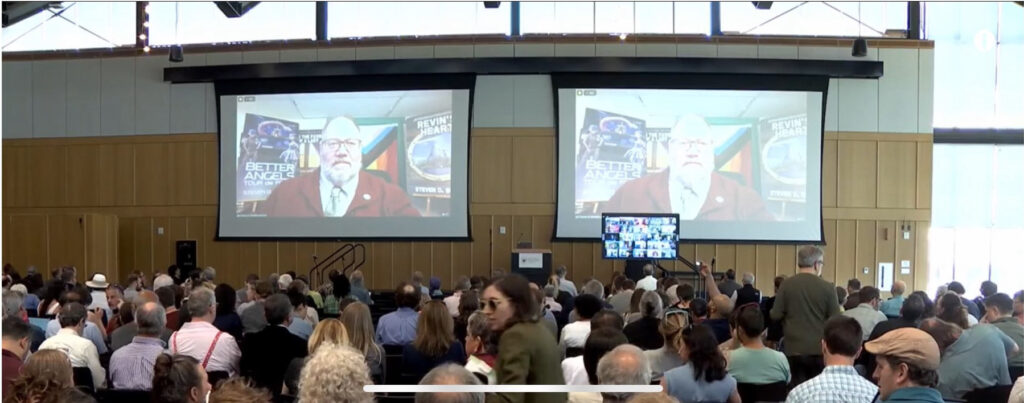
    I began trying to imagine the words that shouldn’t be used to describe AI speech. In chatting with Philip, I said, “AIs can’t ‘promise’ anything either.”

    “They can say they do, though. They can say anything.”

    “They can say anything. It just doesn’t mean anything.”

    “I don’t know,” he said. “It ‘means’ something, in the sense that a string of words means things. I mean, the AI can’t mean anything, because it has no agency, and no real existence. But the WORDS mean things, which is how we get this puzzlement.”

    I disagree. Here’s the thing. Statements (strings of words) never mean anything on their own. The receiver always has to ascribe meaning to a statement. This is a fundamental tenet of social constructivism: You can’t transmit meaning — only words. You probably had a meaning in mind when you transmitted the words, but the other person receives the words and has to construct their own meaning from them.

    In a normal case, one makes the assumption that the statement meant something to the person who made it. When the receiver ascribes meaning to it, they make assumptions about what it means to themself and what it may have meant to the speaker. And, in this way, interlocutors negotiate a shared understanding. But things don’t mean anything to AIs. So you’re projecting meaning onto something that isn’t there.

    It reminds me of Wittgenstein’s “Language Game.” Wittgenstein began his philosophical inquiry with that the idea that propositions (human statements) are (1) tautologies or (2) contradictions or (3) neither. He agonized over what would could be said and what could only be thought or shown. But, eventually, he came to call language a “game” and recognized that one of the principal outcomes of language was that most of what could said were things that had no corresponding referent in reality. I think he basically gave up on philosophy as a meaningful endeavor.

    AIs are the language game as simulated by machines. Nothing they say has any referent. There is no intentionality or thought process behind their utterances. But when people see a statement, they are seduced into imagining there must consciousness and meaning behind it. I would recommend people not give into the temptation. AIs are not trying to accomplish anything. They do not have motives. Or goals. All they do is generate text that looks like an answer.

    Do not project intelligence onto them. In fact, I would recommend not using them at all.

    The people who are creating these machines obviously do have motives and goals. And it would be a mistake to believe that their goals align with yours.

    → 8:37 PM, Feb 14
  • The Language of Flowers

    an iris which means

    When I wrote Revin’s Heart, I realized that one thing that the protagonist couldn’t really do was talk about plants. He didn’t have any background to have learned about plants.

    I love plants and wanted a character that could talk about them. So I wrote in a botanical garden and a curator to run it, Lady Cecelia. She appears for the first time in Storm Clouds Gather. She didn’t have much backstory at first. Momo, one of Revin’s love interests, addressed her as “aunt” so she was the sister of the Baron’s wife.

    She appears again in Then They Fight You when Revin wants to make a corsage and Cecelia advises him regarding flowers to choose:

    “These yellow lilies are pretty,” Revin said, remembering the yellow dress Momo wore on the first day he met her. 

    “Oh, no,” Cecelia said. “No, no, no. In the language of flowers they mean falsehood. No, a white lily, that would be more appropriate. Or perhaps one of these orange blossoms — those mean ‘purity equaling loveliness’. Does that suit, Sir Revin?”

    I was fascinated by the idea when I first learned about the language of flowers. I wrote a blog post in 2020 describing it and mentioning some haiku I wrote (unfortunately posted at twitter) that were inspired at the time by the language of flowers.

    I subsequently wrote a whole series of novelettes, Lady Cecelia’s Journey, that tell her backstory. I had hoped these would start appearing by now, but they haven’t. The language of flowers plays a small role in one of those stories as well.

    For the Wandering Shop Stories prompt today, the word was #rue which immediately put me in mind of the language of flowers. so I wrote a brief story fragment featuring Cecelia and her sister Serena.

    Serena entered the botanical garden in Ravensbelth.
    Cecelia was taking notes in her notebook. She looked up and smiled.
    “And how is my sister this morning?” she asked.
    “I am well,” Serena replied. “But I need to send a bouquet to… an acquaintance.”
    “We have a lot of nice blossoms,” Cecelia replied. “Some roses are blooming, as well as nasturtiums and mallows.”
    “Oh, no,” Serena said. “No. Do you have any rue?”
    “Ah,” Cecelia said. “So this is that kind of bouquet. Yes, I have some rue. And what else would you like?”
    “Evening Primrose? Saint John’s wort? Tansy?”
    Cecelia sucked air through her teeth.
    “My… Yes, I have those.”
    Serena thought for a moment.
    “Any colt’s foot?” she asked.
    Cecelia shook her head. “No, those are out of season.”
    “A pity,” Serena said.
    “Would you like me to cut and arrange them for you?” Cecelia asked, getting out her clippers.
    “No,” Serena said. “For this, I’d like to do it myself. But would you keep me company?”
    Cecelia smiled and nodded.

    In the previous times that I wrote about the language of flowers, I included in the text what the meanings were, so the reader would know. But this time I didn’t. So I thought I might clarify using this blog post. Here’s what Cecelia and Serena are talking about:

    Rose: Love (and many varieties with similar meanings.)

    Nasturtium: Patriotism.

    Mallow: Mildness (and several varieties with similar meanings.)

    Rue: Disdain.

    Evening primrose: Inconstancy.

    Saint John’s wort: Animosity. Superstition.

    Tansy: I declare war against you.

    Colt’s Foot (tussilage): Justice shall be done you.

    These meanings are drawn from Language of Flowers by Kate Greenaway (1846-1901).

    → 5:01 PM, Feb 6
  • A Well-Attended Reading in Elegant Surroundings

    LJ Cohen reads in front of a sizeable audience

    On January 31, 2026, I gave a reading from A Familiar Problem as part of the Straw Dog Writers Guild January Showcase. Authors who published a book in 2025 were eligible and a dozen were drawn from a hat. I got to read third.

    As I arrived, the traffic in downtown Northampton was terrible. I had left plenty of time because I know that parking can often be hard to find, but just getting to the venue was a challenge. Luckily I found a parking place without difficulty and arrived in good order.

    There was a sizeable audience. The Straw Dog Writers Guild tends older, female, and queer. I think there were two other men besides me. But I’ve been involved with Straw Dog long enough that I’m nearly a fixture, so I always feel welcome.

    The reading was held in the Calvin Coolidge Memorial Museum in the Forbes Library in Northampton. The wood paneling and large portraits of the former President and his wife made for an elegant backdrop to the reading.

    Lindsay Rockwell (pictured to the left) led the organizing for the event and welcomed the audience. I’ve served with Lindsay for several years on the Program Committee and she did a fantastic job bringing everyone together.

    Andrea Hairston served as emcee. She introduced each author and brought an enthusiastic energy to the role.

    Most of the readings were of poetry or memoir. My offering of my weird speculative fiction was accepted with good humor, although someone always comments how weird my writing is. And I don’t even read any of the REALLY WEIRD bits.

    One of the readers, LJ Cohen (pictured at the top), also write speculative fiction. I know her from Mastodon and we’ve met a couple of times at conventions (Arisia and Readercon). I decided to buy a copy of her book and got her to sign it.

    After the reading concluded, I was able to pitch my books. I even sold a couple.

    After I left, I saw why the traffic had been so congested: there were ice sculptures all over town, beautifully illuminated in the dark. It was a nice way to end the day as I headed home.

    → 10:53 AM, Feb 1
  • SFWA Winter Worlds of Giving

    coins

    The Science Fiction and Fantasy Writers Association (SFWA) does an immense amount of work in support of the writing community. In the next few days, our Winter Worlds of Giving fundraising campaign will wrap up. Please give generously to support our activities for the coming year!

    Currently there is a matching program, generously funded by Victoria Roth, that will TRIPLE donations from SFWA members up to $10,000. All donations go to the Where the Need is Greatest fund which lets your money support whatever new challenges come up.

    I joined the Board as Secretary in 2024 and have been genuinely impressed by the dedication and commitment of our staff and volunteers. Everyone is working as hard as they can to maintain and enhance existing services, bring a lively new program of professional development, and confront emerging challenges to the writing community. So whether you’re a current member, a Nebula attendee, or a fan of science fiction and fantasy, I encourage you to give generously to the Winter Worlds of Giving before the campaign wraps up on Saturday, January 31. We can do more together!

    → 9:57 AM, Jan 28
  • Some Extra Tanuki Time

    close up picture of boxer dog

    I have gotten essentially no fiction writing accomplished during this Intersession. My university contract says most of January is a period of non-responsibility so each year I can usually get a lot of writing done in those weeks. But this year, my mentally ill adult son was hospitalized for the first time in four years.

    I’m not going to write about his mental illness diagnosis or experience. As my wife would say, that’s not my story to tell. But the impact it’s had on our family does feel like my story to tell. And I think it’s important to share, because many people shy away from talking about mental illness in our society because they’re ashamed. The demands his chronic illness put on our family may be less visible, but they are very real.

    For the past two years, he’s lived independently, though fortunately close enough that either my wife or I can visit daily. We had expressed growing concerns and uneasiness for several days before he was hospitalized and tried to provide nearly round-the-clock support. I stayed with him during the day and she stayed with him in the evening, including hanging out on his couch one night. But, in the end, after about three days, he still needed to be hospitalized.

    This is the fourth time he’s needed hospitalization over the past seven years, but this is the first since he began living independently with his emotional support animal. While he is hospitalized, care for her has fallen to my wife and me — in addition to following his care, ensuring all of his professional supports are coordinated and, of course, one of us going to daily visiting hours to see how he’s doing and (struggle to) stay connected.

    For me, taking care of his young dog is a genuine pleasure. She’s a little weird, but boxer dogs are always a little weird. On the one hand, boxer dogs are so similar to one another, they might as well be clones. But, on the other, they all have unique idiosyncrasies. She is adorable, and I love her to pieces.

    That said, it’s been hard. Trying to keep track of another set of needs is almost more than I can handle now. Despite masking everywhere, my wife has a bad cold that’s interfering with her job. It’s been rough.

    I was really disappointed for myself and other panelists that I felt compelled to withdraw from Arisia. I had been scheduled to moderate one panel and appear on four others.

    Still, I have managed to accomplish a few things. I submitted my application for the Lambda Literary Writers Retreat. My article about bookselling, How to Hand-Sell Books for Fun and Profit, appeared at Planetside. I’m scheduled to read from A Familiar Problem for the Straw Dog Author Showcase on January 31. And I got my university course website published on schedule, one week before the start of classes for Spring 2026.

    Yesterday, due to the massive winter storm, I could not safely attend visiting hours, so I used the time to install FreshRSS and take a nap. I also managed to write a story fragment for @wss366. I’ve only managed about half the days since this all started.

    Every day of hospitalization is a trial in multiple ways. The dog — and all of us — want my son to be ready to come home. We’re doing the best we can for the moment, making sure she gets lots of love and walks and treats. But it’s hard for her and hard for us. And still will be for weeks after he does return to his place, as he recovers. She is ready to do her part doing what she does best, providing unqualified emotional support. She is ready.

    → 2:37 PM, Jan 26
  • Finally Set Up FreshRSS

    I spent a snowy afternoon setting up FreshRSS at my hosting service. It was a snap. It really only took me about a half hour once I got started and made me wonder what I’d been waiting for. I’ve only just started exploring it’s capabilities, but it seems great so far.

    One of my fellow authors at Water Dragon Publishing shared a bit of news at the Discord and indicated she would be providing further updates to her blog, if people wanted to follow her journey. I had been meaning to set up a new RSS feed reader for a couple of years and so this was just the prompt I needed to kick me into gear.

    I was an avid user of Google Reader and then, for many years after, ran an instance of TinyTinyRSS (TTRSS) as a feed reader on my home server. At some point, however, TTRSS began to require Docker. When I tried to set it up, it didn’t work right — probably because I got something wrong in the Docker configuration — and I said, “#@&% this!” I wasn’t going to teach myself Docker just so I could play at being sysadmin.

    I tried a few other app-based feed readers, but I really wanted something server based. Otherwise, you really can only check your feeds from a single device and I switch among three devices pretty much constantly. I had identified FreshRSS pretty early on as a good candidate, but I wasn’t sure it would play nicely with my hosting service. I had tried to install TTRSS there and that hadn’t worked (which is why I had been running it on my home server).

    In the end, I just did it. I downloaded the source, checked the documentation, and got started. I re-used the domain name “feeds.bierfaristo.com” that I had created a few years ago and added hosting. I scp’ed the tar file, untar’ed it, and the pointed my browser at the URL. Bam! I was in business.

    I had saved an OPML file of my old feeds, which I went ahead and imported. It was a trip down memory lane. A lot of the feeds were dead, but a surprising number are still good. I’m looking forward to being more intentional about keeping up with feeds again.

    → 5:51 PM, Jan 25
  • Bookselling 101: How to Set Up & Run a Dealer Table

    Books for sale on dealer table at LOSCon51

    At Worldcon, I got the chance to chat with Roxana Arama, the editor of Planetside (formerly the SFWA Blog). We had a great conversation and she encouraged me to write a pitch for an article. 

    Upon reflection, I decided to pitch an article about hand-selling books for authors as a kind of Bookselling 101. Since I had time in August (and was likely to have less time once the academic year started), I went ahead and drafted the article even before my pitch was accepted, figuring I would post it to my blog if it didn’t get accepted.
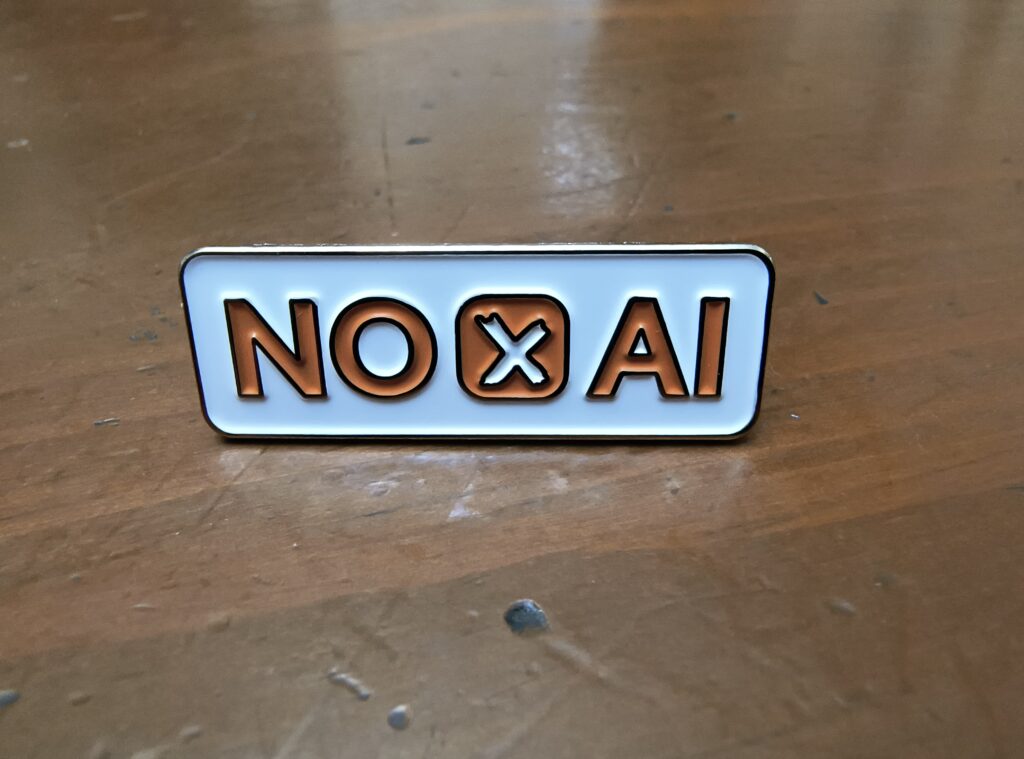
    My pitch was accepted, but with a modification: They wanted a Bookselling 201 article and were most interested in having my expand on the aspect about pitching and hand-selling books. I made the necessary revisions and the article, How to Hand-Sell Books for Fun and Profit, is now live at Planetside.

    I thought it would be fun to share the rest of the Bookselling 101 article I wrote here. 

    Where to Sell

    There are a large number of opportunities where you might be able to sell your books directly to an audience. Perhaps the most important are the national and international conventions, like Worldcon, Dragoncon, and Comicon. Regional and local conventions are also worth attending. Additionally, there are often a vast number of local events that will welcome an author selling their books, including festivals, artisan markets, and holiday markets.

    Conventions usually have a “dealer room” where most of the bookselling happens. Dealers pay a charge to have a space in a room with other dealers where they can sell their wares. For an individual author — especially a beginning author — the charges for a table may be higher than are warranted. But there are sometimes ways to share the cost. It may be that your publisher will already have a table. Or will pay to have the table, if you volunteer to help staff it to sell your books and others from the publisher. Some groups, like Broad Universe and Small Publishing in a Big Universe (SPBU), offer tables that multiple authors may join and share. Many conventions also offer other opportunities for individual authors to sell their books, in an “author’s alley” or via book-signing events.

    Your Personal Brand

    Presenting yourself and your books effectively makes a good first impression. Branding works. Many authors use some props to create a distinctive author appearance: a distinctive hat, like Tobias Buckell’s beret, or a T-shirt with a graphic design that evokes or aligns with your brand. A tablecloth and tablerunner, or banner, with branding are worth having to give your bookselling operation a polished, professional appearance. 

    Branded giveaways are useful to remind people about your books after they’ve walked away from your table. A business card, with a QR code linking to your website, is a no brainer here. But there are a lot of other easy and fun possibilities. Bookmarks are an obvious choice. Stickers can be good, although they’re more expensive and some venues ban the distribution of stickers. Some conferences use badge ribbons and, if you can think of a catchy hook, they have the added advantage that other attendees may see other people wearing the ribbon and will come to your dealer table because they want to get one of their own.

    If people purchase several books, it’s convenient to be able to offer a bag to help them carry their books away. Be aware that in some localities, disposable plastic bags are outlawed, so paper bags are safer. The bag is another opportunity for branding: A rubber stamp works well, but stickers or labels can do in a pinch. Alternatively, you can purchase some branded reusable bags to sell.

    Practical Concerns

    Books are heavy, so a collapsible cart or wagon can be invaluable for moving your books and other materials during load-in and load-out. Stout cardboard boxes are ideal for protecting your books. But high quality reusable grocery bags with a flat bottom are convenient too and have the added advantage of handles. Book stands are also useful for standing up just a few books to highlight. (They’re also useful for when you’re a participant at a panel, to show your books while you present!)

    It’s fun and easy to also sell books at outdoor festivals and markets, but you need some additional resources. You will probably want a collapsible 10×10 foot tent. Some are much easier than others to transport and setup by single person, so consider those factors when making your selection. Also, be sure to get some weights so that your tent doesn’t blow away in the wind. (Ask me how I know this…) You’ll need a table and some folding chairs. Usually tables and chairs are provided in dealer rooms, but for most festivals, you’re on your own. An 8-foot folding table works well. But two smaller tables — or just an additional table — can provide some flexibility.

    Hand Selling Books

    The most important thing I’ve learned about bookselling is that a concise, polished pitch for your book greatly increases your chances for making a sale. My article at Planetside, How to Hand Sell Books for Fun and Profit, goes into more detail about this.

    Financial Concerns

    Before selling anything you should make sure you have your financial ducks in a row. If you are selling on behalf of another organization, like your publisher or SPBU, they may have taken care of these details beforehand. Otherwise, you should consider setting up a separate bank account for you to keep the finances of your bookselling operation separate from other activities. 

    Honestly, if you’re a professional author, you should already have a separate bank account for business income and expenses. But, if you’ve resisted that up to now, stop resisting — you really need that, if you’re going to be a book seller.

    Before you start selling, you will probably need a Tax ID number in order to collect and report sales tax. The rules and the amounts can vary widely depending on the locale. The rules for this vary from state-to-state or even city-to-city, so be sure to check the laws carefully in your locality.

    You will need to accept payments. There are a few payment processors that offer inexpensive integrated systems you can use as a Point-of-Sale terminal. Many cell phones now can accept NFC (tap) payments with one of these using a card or phone or smart watch. There are also inexpensive devices that can accept tap payments, but allow someone to also insert a chipped card. These systems generally impose a 3-4% charge, which you will need to price your products appropriately to cover.

    Different events bring people with different preferences for how they want to pay. Most transactions are usually via credit cards but, at some events, many people will want to pay cash. An envelope containing small bills is useful and that can also hold the cash collected. I usually start with $100 in one, fives, and tens to make change. I can then easily calculate the additional cash collected by the end of the event, to confirm it matches the transactions recorded in the payment processing system. Some events and populations prefer yet other payment systems, like venmo or paypal. It’s useful to be able to accept payments using whatever system the customer prefers.

    I’ve generally found it convenient to price products at even dollar amounts that include the taxes and payment processor charges. Remember that, if you price something at $11, you will need a large number of ones and fives to make change, if you have many cash sales. 

    I’ve found that printing price tags on florescent card stock is useful. I have a template with prices along the edges that I can cut in half and then cut between the tags. These are easy to tuck in between the pages of books, so they stick up and are highly visible. You can use the different colors of tags to indicate various things: e.g. price range or genre. People like to know how much things cost. If you don’t have price tags, people will need to ask you, which will deter sales.

    So, that’s it. That’s pretty much everything I know about selling books. Yep, that’s pretty much it. Oh, except you need some books to sell. You should probably go write some books now.

    → 2:56 PM, Jan 20
  • Wandering Shop Stories for 2026

    icon for wss366

    Wandering Shop Stories, a prompt for writing microfiction on Mastodon and Bluesky, begins its third year in 2026. It has grown modestly from having three to six curators and nearly 200 followers. Every morning, at 5am Eastern, a post appears on both services with a prompt for the day that proposes an ordinary word with multiple meanings that invites people to write a short piece of microfiction that includes the word and to tag the post so that everyone can follow along.

    Starting this year, we decided to add a new wrinkle. Until now, we just selected a word based on the day of the year (day 1 to day 366 — on leap years). This year, we decided to track calendar days and holidays, to allow us to consider specific words for special days. This isn’t to say that we necessarily will, but we added the infrastructure to make it possible.

    In technical terms, our new curator Gary created a new column in our spreadsheet with the dates and then we repurposed the “explanation” to column to list holidays. I added in a few US and Japanese holidays. (For several years, I’ve been subscribed to a Japanese holiday calendar in my daily calendar, which has been a source of great enjoyment and enrichment.) Then Nara and others went through and added a bunch more holidays from various calendars.

    Once we had the structure laid out, I modified the python script that actually makes the posts. I reworded the post slightly and added a conditional to only identify the holiday if it is a holiday. When I made the change, I got the syntax slightly wrong so, this morning at 5:00am, the script ran and failed with an error. When I woke up a few minutes later, I checked and, seeing the post hadn’t gone, logged into the server to check the error log. I had forgotten a colon (well, two actually). So I added them and ran the script manually.

    Post by [@wss366@wandering.shop](https://micro.blog/wss366@wandering.shop)
    View on Mastodon

    I really love our little #wss366 community! I love writing to the prompt every morning myself as a creative warm-up for the day. Furthermore, it’s been a real joy for me to see other people engage with the prompts and to read the contributions they write. And every quarter that our little group of curators has met via zoom to chat has deepened my appreciation for our quirky little community. Thank you both to participants and curators for investing your time an energy to bring our little community to life. Here’s to another successful year of Wandering Shop Stories.

    → 11:36 AM, Jan 1
  • RSS
  • JSON Feed
  • Micro.blog