Cover Reveal: A Familiar Problem
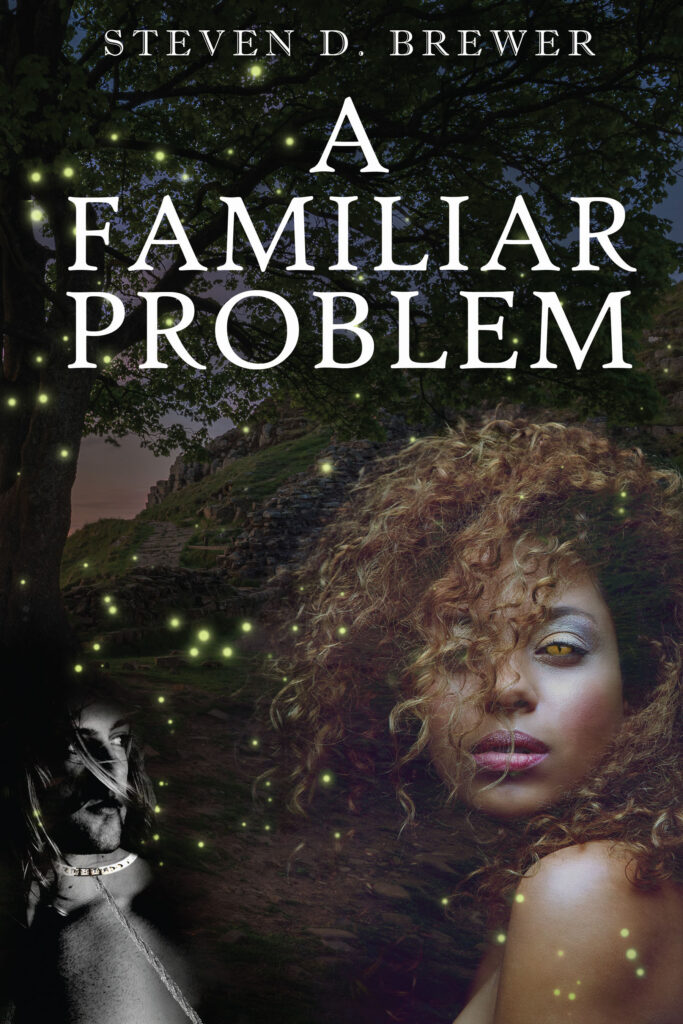
Becoming a powerful demon’s familiar might be the best thing ever. But what’s the catch?
Rory Soletsa is supposed to find his magical familiar, but he doesn’t want something trite, like a cat; or stupid, like a bird; or ugly, like a toad. He wants something cool and powerful that can be an ally in a fight. When he’s captured and made into the familiar of a powerful demon — who presents as a voluptuous, beautiful woman — he’s amazed as he begins to discover how much more powerful his magic is with her. And he’s ecstatic when the demon offers to train him in advanced offensive and defensive magic. But just what is she training him for?
A Familiar Problem, coming soon from Water Dragon Publishing!
WorldBuilding 101
On November 9, I got to host James Cambias doing a presentation about Worldbuilding for the Straw Dog Writers Guild. He wanted to do a face-to-face presentation, so I reserved the newly built North Amherst Library Community Room. It’s a great venue with a large-screen display, four tables, and maybe 30 chairs.
Unfortunately, not many people came. He pointed out that if the number of presenters outnumbered the audience, we were obliged to take the presentation to bar and we avoded that, but only barely.
But it was a fantastic presentation and I’m sorry more people didn’t attend.
Here’s the little introduction I wrote:
Hello. I’m Steven D. Brewer and I would like to welcome you to Worldbuilding 101 with James Cambias presented by the Straw Dog Writers Guild.
Straw Dog is a non-profit volunteer organization dedicated to the craft and transformative power of writing, designed to serve writers throughout the region by promoting individual growth, community outreach and enrichment, and community building.
Our mission is to support the writing community by strengthening, engaging, and connecting writers at all levels of development.
Some upcoming events
Tonight: Everyone Reads Second Sundays Open Mic
Wednesdays: Straw Dog Writes
Nov 13: A Writer’s Night with Linda Cardillo at Longmeadow Adult Center
I first saw James Cambias at a reading with Elizabeth Bear and Max Gladstone at the Odyssey Book Shop in South Hadley. Since then, we’ve crossed paths at science fiction conventions in Boston, like Arisia, Boskone, and Readeron, where we’ve done readings and served on panels together.
Born in New Orleans, educated at the University of Chicago, James has been a professional science fiction writer since 2000. Among his novels are A Darkling Sea, Corsair, Arkad’s World, The Godel Operation, The Scarab Mission and his most recent, The Miranda Conspiracy. He also designs roleplaying games, and is an advisor to the Center for the Study of Space Crime, Piracy, and Governance.
This afternoon, he’s presenting Worldbuilding 101: In science fiction and fantasy, the strength and depth of the author’s world building can make the difference between a forgettable story and a classic. He will breakdown how to make convincing and interesting worlds for your stories, while still respecting realism and scientific accuracy.
And, with that, please welcome James Cambias for Worldbuilding 101.
James provided a brief preamble: Worldbuilding is a form of storytelling, in itself: An act of literary creation. That said, story considerations should remain paramount. When building a world, the purpose is to support the story. And he offered his own test:
The Cambias Test: Any alternate world needs to support adventures/stories that you can’t do here.
In other words, if your story can take place in the regular or historical world just do it. Don’t go to a bunch of extra work: just do the work that is necessary. Sometimes you have a setting that already exists (like shared worlds — I write stories set on the Truck Stop at the Center of the Galaxy) and you can just look up the necessary information, but he encouraged the audience to fit the story to the world.
He challenged the audience to consider what motives and conflicts that the setting supports. He cited Aristotle who proposed desire, fear, and honor (or, as we might say conviction, today). This reminded me a bit of the four F’s of animal behavior: Feeding, Fleeing, Fighting, and Reproducing. In science fiction, survival is clearly one motive.
He proposed to look for “signature events”, that is things that happen there that don’t happen on Earth. The terminator on Mercury moves at walking speed. For sandboxes and shared worlds: what are some signature events there that nobody has done. Find a new angle. Take it seriously or don’t do it. And for the real world, take is seriously — Do the research! You can often use the results to add details that will contribute to the verisimilitude of the story.
He then let the audience in an exercise in worldbuilding, to design a world and its alien inhabitants. He offered a worksheet that indexes planet size against temperature to help determine the characteristics the world will have. What kind of planet do we want? How habitable? Can humans live there?
He began with the star in terms of size and brightness (luminosity, which describes the brightness as compared with the sun). Large stars frequently don’t last long enough for the establishment of a stable biosphere within its solar system.
He then moved to the planet. It’s characteristics include distance from the the star, the size and density, which together determine the gravity.
Running short on the time, he touched on life. Isaac Asimov wrote an influential article, Not as We Know It: The Chemistry of Life that provides a good introduction to what is required for life: a liquid, a solvent, and some kind of information molecule. (Personally, I would approach defining life differently, not in molecular terms.)
Aliens don’t have to be from the planet the story is set on. They can play a variety of roles: as people, a threat — as individuals or a society — as victims, or a mystery. And can transform: from a mystery to a threat to people.
Aliens can be of a variety of types. Talking beasts, super brains, an elder race, warriors, hive minds, or weird things. These often come with implied roles: for example, talking beasts are generally threats and weird things are generally mysteries.
It was a fantastic presentation and got me to think a lot about my own writing. In my writing, I’ve generally felt that aliens are extremely unlikely to have a compatible biology to our own. So the idea of “away parties” visiting alien worlds and talking to aliens… I just don’t see it happening.
Maybe Not My Every Fantasy

People crave and need attachment. Increasingly people are turning to AI rather than people. One company had created a pre-AI chatbot with scripted responses that was highly effective at fostering engagement. But when they saw how people used it, they began to have serious reservations.
Not only did people crave A.I. intimacy, but the most engaged chatters were using Kuki to enact their every fantasy. At first, this was fodder for wry musings at the office. […] Soon, however, we were seeing users return daily to re-enact variations of multihour rape and murder scenarios.
I realized as I read this that my fiction writing is similarly very much about enacting my fantasies — or, at least, fixing them in tangible form — though perhaps not every single one.
When I was young, I would lose myself in fantasies every night before going to sleep. And at any time during the day, might find myself woolgathering, imagining all sorts of fantastic things.
I fantasized about all sorts of stuff. Some fantasies were pretty ordinary: I remember at point having fantasies about building a large enough model airplane that I could fly in it. But a lot of fantasies were pretty weird and highly sexualized. I started having these sexualized fantasies at a very young age: 6 or 7 or 8. These were a staple of my life throughout my youth.
When I was a doctoral student, I suddenly lost my ability to fantasize. I realized eventually it was because I was confronted with a problem I didn’t know how to resolve. My dissertation was like a mountain range. I spent a year going back and forth in front of the mountain range, looking for a pass through the mountains. Eventually, I realized there was no pass, and so I started climbing up one mountain and then the next and then another. In the middle, I couldn’t see any end: there were mountains in every direction as far as I could see.
During this time. I was caught on the horns of a dilemma: I couldn’t engage in a fantasy that didn’t involve either having finished my dissertation — and I didn’t know how that could happen — or having given up. And I wasn’t going to do that! So I was stuck. It was horrible and I remember worrying at the time that the effect would be permanent.
Eventually, years after I finished, I gradually began to be able to fantasize again.
During the pandemic, I found myself constantly tormented by negative thoughts. I called it the Hamster Wheel of Doom: one negative thought led to another and another and eventually back to the first. I rediscovered finding refuge in fantasies. And I began writing fiction primarily as a way to fix one part of the fantasy so I could move onto the next part.
As I read that article, however, I began to wonder how different my indulging in my fantasies to write is different from using one of these chatbots. Like them, I’m just playing with my ideas. The only difference is that I play all the parts myself, rather than having some kind of assistive support. But is it really all that different? I dunno.
Minimally, I’m not sharing my fantasies with some faceless corporation. I’m sharing them with the public. And on my own terms. So there’s that.
And maybe not every one of my fantasies.
No Sale, No Fee, Just Fun

The Straw Dog Writers Guild arranged a table at the Northampton Antiquarian Book, Ephemera, and Book Arts Fair where authors could sell and sign books. I attended and had a two-hour shift at the Straw Dog table. Although I didn’t sell any books, I met some new people, reconnected with others, and had a great time.
The event was held at the Northampton Center for the Arts. It’s a fantastic building with many interesting spaces. The Straw Dog table was right in front of a counter that would have been great as a bar for a reception. Unfortunately they weren’t serving.
Most of the vendors were dealers in antiquarian and rare books, but there were a few literary organizations and specialty presses. As a group of current authors, Straw Dog was not a particularly good fit and few of the visitors seemed that interested in current work. It reminded me a bit of Boskone, where many attendees want to see books by Heinlein and Asimov, rather than new authors they’ve never heard of. And, at this event, what they really wanted were signed first editions.
I arrived very early, in hopes of getting a parking space and was rewarded by getting the very last one. I suspect that not arranging for vendors to be able to unload and park at a distance to let attendees use the limited parking probably limited the number of visitors a lot. But, at least, I didn’t have to schlep my books a vast distance when it time for my shift.
I used the two hours before my shift started to wander through the whole space and see everything. There was a lot of really cool stuff. I love old books. The fact of the matter is, however, that I would be a very poor caretaker of them, so I never buy anything like that for myself. But it’s fun to look.
In addition to books, there were other interesting things. One artist had a book made with interesting handmade papers. There were various kinds of manuscripts (old property deeds and log books). One was printing with old type that had been recovered by the Yiddish Book Center. It was all fascinating.

When my shift started, I set up my books. I only brought a few copies, since I wasn’t expecting strong sales. But I also had a sign-up sheet for my mailing list; and cards to give away for myself, A Familiar Problem, and my proposed Amherst Book Festival. Plus some Airship Pirate stickers.
I spend the most time talking to the author next to me at the table. She was easy to talk to and we swapped stories while we waited for people to stop by. We would trade off talking to people that expressed interest in our books. I ended up buying a copy of the book she was promoting, Jingle These Bells, an inclusive holiday-themed romance anthology. Her story sounded fun.
I was pleased when Andrea Hairston came by the table. She let me pitch my books to her and expressed enthusiasm. We had served together on a panel at WriteAngles and I had seen recently that she has been selected as the speculative fiction instructor for the Lambda Literary Retreat for Emerging LGBTQ Voices this year. I mentioned that I had applied for the retreat last year, but was not selected. She warmly encouraged me to apply again this year, so I probably will.
In the end, I didn’t make any sales. But the time spent meeting and reconnecting with people was well worth it.
Headed to LOSCon

Back in July, I pitched a panel for LOSCon. It turns out that my panel was accepted! On Saturday, I will moderate a group of panelists to discuss Poetry and Songs in Speculative Fiction. I’m really looking forward to it. I’ve got some idea for questions. I reached out to the panelists, but haven’t gotten much back yet. I think it will be easy to talk almost endlessly about the theme. It’s a fascinating topic.
On Friday, I will be a panelist discussing Biology in Science Fiction and Real Space. I was nicely prepped for this one by the recent presentation on Worldbuilding 101 by James Cambias. And, of course, if you stick a microphone in front of me to talk about biology, I can babble endlessly.
On Sunday, Developing a Creative Habit. This is kind of a funny topic for me, since my pitch is really the anti-habit. I wanted to talk about how, while many authors love to develop a habit to be productive, I would rather just let my creativity happen randomly. Sometimes it happens and sometimes it doesn’t.
My publisher is going to have a table in the dealer room. My new book, A Familiar Problem, is scheduled to come out Dec 9, 2025 — too late for the convention. But there’s a chance a few copies will arrive in time. I’ve got my fingers crossed.
I usually suck at meeting people at conventions. But I’m going to make a particular effort to meet people involved with organizing the coming Worldcon in Los Angeles. Or, rather, Anaheim. Wish me luck!
My LOSCon Experience
With an hour to kill at LAX on my way home from LOSCon, I thought I’d take a few minutes to reflect on the experience. It was generally good: my travel arrangements went well (at least so far) and the accommodations were satisfactory. And in spite of a family member coming down with a cold before I left, I did not become symptomatic during the convention. We’ll have to wait to see whether I managed to dodge the bullet again after I get home.
I had a light schedule this time, with three panels in total, one for each day of the convention.
I was a participant for the first: Biology in Science Fiction and Real Space moderated by Jane Shevtsov. She did a presentation just before the panel which gave me an opportunity to learn more about her. She hadn’t contacted us beforehand, so we didn’t have any sense for how the panel would be organized. But it went reasonably well and I was able to think fast enough on my feet to feel like I made reasonable contributions.
I was the moderator for my second panel: Poetry and Songs in Speculative Fiction. This was a panel I had proposed. I had noticed the one of the participants was on my previous panel, so I made a point of introducing myself. The other two were on another a poetry panel the previous day, so I attended that one to hear them speak and, again, to introduce myself.
There were a couple of disappointing outcomes. The venue was half of a room separated with a divider and the session on the other side was extremely noisy. The con staff made some attempt to ameliorate the noise, but it was still pretty bad. The attendance was also quite poor. The poetry panel on the previous day had also been poorly attended, so I wasn’t surprised. But it was still disappointing.
I had forwarded to them a set of questions the previous week:
Please introduce yourself and, since we mentioned Tolkien in the panel description, was there a poem (among the ~60 or so) in the Hobbit or Trilogy (or elsewhere) that particularly resonated with you and why?
Poetry and meter were probably memory aids for stories in an oral tradition that carried over to the earliest written stories, cough, Gilgamesh. What other reasons do authors use poetry?
Songs present unique difficulties to represent on the printed page. What are some of the challenges to using poetry and songs in fiction? What are some ways it can fail or miss the mark?
Do you write poetry and songs yourself to include in your fiction? would you like to share some?
Movies provide a more natural medium for including music and song. How do their uses differ from printed fiction.
If we haven’t mentioned KPop Demon Hunters yet, what were particularly effective — even revolutionary — uses of song in that movie?
What are other authors and stories that use poetry and song particularly effectively?
They each brought interesting and unique perspectives on the questions. I was surprised that one of the participants had never read The Hobbit or Trilogy. And two of them had not seen KPop Demon Hunters. I was really surprised by that. But we had a good discussion about the topic and I learned a lot.
The last panel I served on was Developing a Creative Habit. This was a great panel. By this point, I had seen all of the participants and so I had a pretty good sense for how the panel would go. My main objective was to present myself as the anti-habit. Although I’m pretty settled in terms of my daily schedule, I’ve learned from long experience that my productivity is extremely variable. I used to stress about it and wanted to encourage others to not worry about it. I described my approach which is to have multiple projects and just write whatever I want whenever I feel like it — or not. This earned the comment, “You, sir, are a weirdo” by M. Todd Gallowglas, which I warmly accepted in the spirit in which it was intended. I also manage to mention Structured Procrastination and Philip’s essay about being routinely creative. And a lot more.
I balanced the rest of my time between other panels and working at my publisher’s table in the Dealer Room. Sales were rather poor — and not just with us. All of the other dealers seemed pretty disappointed by sales.
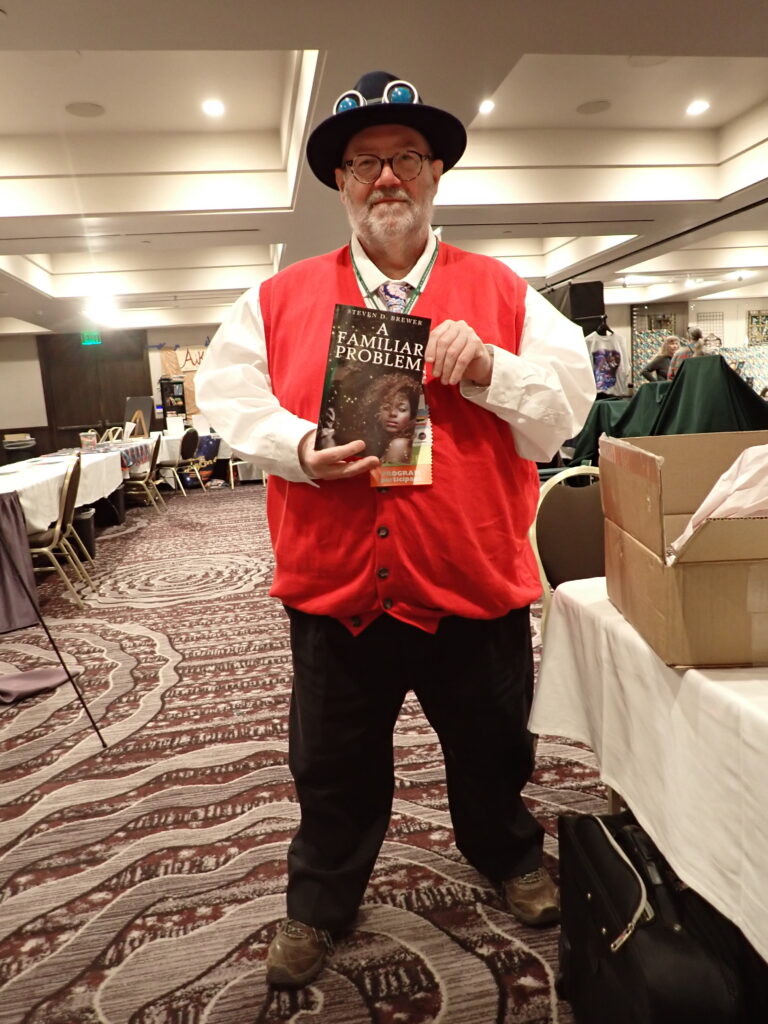
I was excited to finally get to put my hands on some copies of my long-delayed book A Familiar Problem. It didn’t arrive until Saturday evening, so I could only try to sell them on Sunday. By the time the Dealer Room closed, I hadn’t sold one. That’s how it goes sometimes.
I had several hours between when we finished load out and time for my flight. I decided to leave the hotel and spend most of the time in the airport. I’m kind of glad I did because the traffic to get the one mile to the airport from the hotel was miserable and it took almost an hour. Then, going through security, they had to call over some specialist to check the personal oxygen concentrator I need to fly. That took another half hour. But I got through fine and had more than an hour to spare.
And I’ve finished this post at 10pm with just a few minutes before boarding. Ojalá, I will be back home tomorrow before noon.
