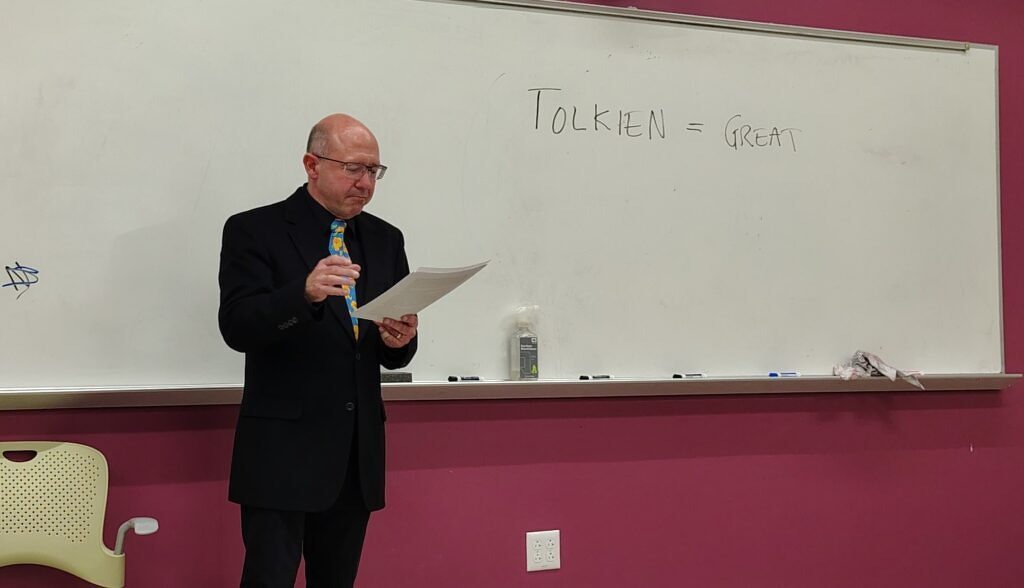
Michael Drout, a prominent Tolkien scholar, gave a talk at UMass Amherst (in part to promote his book The Tower and the Ruin) about what makes the Lord of The Rings (LoTR) “great”.
Like all great English literature presentations, the author brought no visual aids. (This is not quite true, as someone had written “Tolkien = Great” on the whiteboard.) He stood at the front of the room with a copy of his manuscript — which he did not read from — and spoke passionately about his subject. The talk was only sparsely attended, but was excellent and well received.
He began with some evidence that LoTR is great. He cited the enthusiasm of people who can’t wait to read it to their children. And who re-read what is really a very lengthy work over and over again — many people annually. He also argued that book cosplay began with LoTR, tho I don’t really know how true that is.
He admitted that the phenomenon is somewhat weird. People cite LoTR as being more like an experience than a book. It was not considered a serious scholarly topic of study until it became a mass-market cultural product — which is also weird.
Rather than devoting any time to outlining the plot or characters, he described several other features of the books that, to his mind, distinguish the Lord of The Rings and makes it great.
He identified two particular emotional states that combine to make it great: experientiality and heimweh. The story is told through the viewpoints of the least knowledgeable characters, principally the hobbits and — during the run across Rohan — Gimli. This allows the author to give information in a natural way such that the reader learns along with the protagonist. This creates cognitive alignment between the reader and the character. He joked that maybe it is all about what we learned along the way. Tolkien also used repeated interlaced periods of stress and relief throughout the story, such as engagements with enemies (weak attack, strong attack, rescue) and illness and recovery (Rivendell, Lothlorien, Ithilien), that are used as motifs, but then violated at key moments (e.g. Cirith Ungol), to heighten drama and communicate to the reader the gravity of the moment. These motifs are then restored by the end.
When struggling for a word to capture a particular emotional resonance he (of course) turned to German and adopted the term “heimweh” to capture the feeling characters express of longing for their home, or for the past. Tolkien described this feeling “a sadness that was yet blessed and without bitterness.” Google Translate would have you believe that the word just means “homesickness”. This sense of dislocation and longing runs throughout the Lord of The Rings: when Frodo looks back toward Hobbiton and wonders if he will ever look upon the valley again. Or the Elves that departing Middle Earth. Some might call it nostalgia, but Drout assures us they are simply wrong.
He offered a number of minor digressions. He talked about the heterotextuality (a term which he did not invent, in spite of what ChatGPT may tell you). He made a brief mention of elvish racism (basically everything bad that happens to the elves — i.e. everything in the Silmarilion, is due to intra-elvish racism. Or is that inter-elvish racism? I’m not sure.) He further discussed worldbuilding (which he called subcreation), one of Tolkien’s other works, On Fairy Stories, that he persuasively argues that nobody understands (not even him) — and The Black Bull of Norway (a traditional fairy tale, which he warns us to never read because it’s awful.)
He wrapped up with a long personal anecdote to introduce the struggle he had to identify an organizing theme or message for his book. He had begun with “consolation” but decided — rather at the last minute — that this was wrong. And he settled on eucatastrophe — the idea of an unexpected turn to a happy ending. The idea is that the book helps us imagine such a world: the grief and sorrow show us how successes are possible. When I’ve tried to write stories like that, people complain that it sounds like deus ex machina. But I guess that’s why I’m not a great writer.
