It’s been an exciting month of transitions, as I move from employment to retirement. As I transition, I’m starting to have more time and focus for writing again. I look forward to share more exciting developments during the months to follow.
Retiring to… Something
Two years ago, I began a phased retirement. Last Thursday, I conducted a University class meeting for the last time, presided over my final Faculty Senate meeting, and (by coincidence) also celebrated my 38th wedding anniversary. And today — Tuesday — is special because, on my Tuesday/Thursday teaching schedule, I would have been teaching today. (I mean, I wouldn’t have because it’s finals week so class wouldn’t have met anyway, but you get the idea).
My brother, who retired fifteen years ago, recently had a piece of advice for me.
The weeks leading up to retirement, and the weeks after retirement, are particularly nice. Do savor them. Don’t just let them slip by as if they were ordinary weeks.
I’ve been trying to take this to heart.
Although we agree about many things, we sometimes actually come at things from quite different perspectives. He never really wanted to work and pursued a career with the goal of retiring early. I, on the other hand, aimed to find a career that gave meaning to my life and represented what I would have wanted to be doing anyway. I tried to embody the aphorism, “Do what you love and you’ll never work a day in your life.” I am not a spiritual person, but I believe in the sanctity of work.
I decided to dedicate myself to science education. As an edutainer, I had visited hundreds of elementary-school classrooms and had seen how few teachers understood what science really was: Not merely a collection of facts, but a way of knowing and apprehending the world. I believed that improving science education was a potential way to help people make better, more-informed choices about the environment.
When the Internet happened, I was given a front-row seat to helping faculty transform education using technology. For a brief moment, I was in a position to show people how technology could be used, not merely to reproduce the existing paradigm, but to create new environments to foster learning.
The work felt important to me. It seemed like work worth doing. I could make a case to myself that it was worth dedicating my life to the task.
In part, I was motivated by Journey to Ixtlan. It’s a rather silly book. But I read it as a young man and certain themes appealed to me. In particular, the notion that, since death may arrive unpredictably, you should aim to use what time you have intentionally.
This was reinforced for me when I had a cancer scare in graduate school. A barber spotted a questionable mole on my ear and recommended I get it looked at. I made an appointment with the campus health service and a physician’s assistant inspected it. She studied it, pulled out an illustrated guide, studied it some more, paged through the guide, and then finally announced, “I think you’re OK because it looks like this one.”
I said, “You’re pointing at a picture that’s labeled ‘Deadly Melanoma.'” It was. It was literally labeled “Deadly Melanoma.”
She paled. “Oh. Oh! Oh… Let me me go get the dermatologist.”
They took a biopsy and, a week later, the results came back. It was not malignant. They still recommended getting it removed, so I scheduled the surgery. But a week of having that in the back of my mind was rather… focusing.
Similarly, my decision to retire was significantly influenced by my hospitalization when I was diagnosed with a chronic lung condition. This made working and teaching seem a lot less fun. And got me thinking that I had better things to do than keep beating my head against a wall.
As I’ve approached the end of my phased retirement, I’ve attended several workshops where people talk about retirement. One person suggested that, rather than “retiring from” one should aim to “retire to”. For a lot of people, this is perhaps a useful distinction, although it was never really in question for me. If I wasn’t doing work, I would be doing something else creative. I have no shortage of interesting projects I intend to work on in retirement.
I have plenty of things to work on. I have several fiction writing projects. I have several books in progress and a lot of short fiction that I should be shopping around to publishers. I have wanted to make a new book of haiku for a couple of years and just thought of an idea for an accompanying art project that might be fun to work on. There are also some gardening projects that might be fun to try. I would also have fun doing some technology projects again as well. And, of course, there are also my service commitments to SFWA and Straw Dog. There is plenty to keep me busy.
After my two years of phased retirement, I still have several months to savor as I approach full retirement. This week, I’ll get the grading completed for my last class. Since I’m on a nine-month appointment, the summer is a period of “non-responsibility” (or irresponsibility, as my brother likes to joke.) So, although I’ll still be formally employed, I won’t have any more official duties. I can attend a few Rules Committee meetings and join them to meet with the Campus Leadership Council. And August 31 will be my last day. I will have been a faculty member for 30 years and one month.
It’s enough.
Review: The History of Money

The History of Money by David McWilliams (2024) is subtitled “A story of humanity.” It skims over a vast landscape, dipping in now and again for a deeper dive into moments when innovations in how societies created and managed money (or failed to do so) contributed to world-changing events. The complexity of our current world economy has grown up guided and constrained by the cautionary lessons of history, but ever spurred on by people’s greed and prurient interests. This book provides an enjoyable and useful introduction with a lot of fascinating details along the way.
He begins with the earliest known examples of commercial tallies, records of values, and transactions, going back to the stone age. The theme of money shifting between measures of commodities (e.g. grain or precious metals) or value (as anchored by fiat and monetary policy) plays out over and over throughout the book.
Many important historical figures are introduced with the roles they played in advancing innovations in monetary practice and policy. I’ve always lamented that, as someone in the sciences, I had little flexibility to study history and classic literature. McWilliams has prompted me to consider reading at least two important books out of history: Xenophon’s Oeconomicus, the foundational text of economics and Liber Abaci by Fibonacci.
The books ends with a pretty harsh dismissal of cryptocurrencies:
Over the years we have seen that money is a technology designed to solve a problem. I’m scratching my head as to what problem Bitcoin in particular and crypto in general actually solve. Despite the small foothold Bitcoin has gained in the mainstream US investment market, crypto looks set to remain on the fringes, a source of obsession for its supporters and aficionados, but not very useful or practical in reality. Bitcoin is to money what Esperanto is to language.
Other than the slur against Esperanto, I am in complete agreement. I mean, he’s not actually wrong about Esperanto either, but I would have preferred he slander Volapük rather than Esperanto to make his point.
If you’re curious about understanding how money works in practice and how it came to be the way it is, this book is a great place to start.
Enroute to the 2026 Nebulas
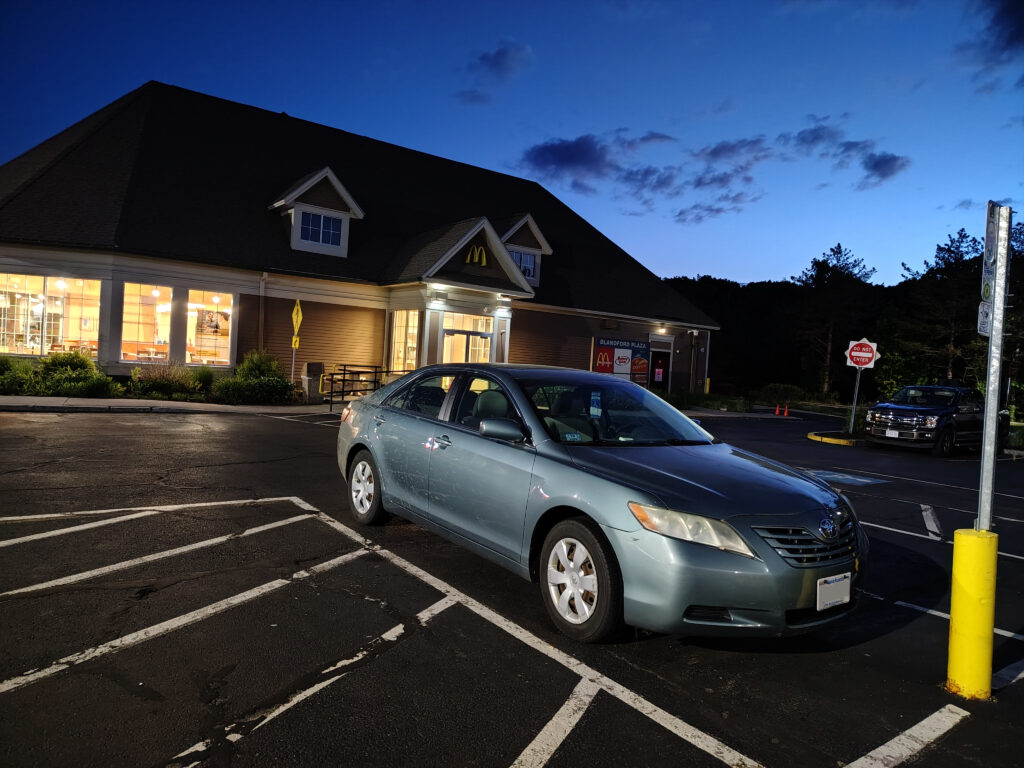
As May ends, I am enroute to the Nebula Awards Conference in Chicago. I am currently rusticating with my brother for a few days before we head up to Chicago on Tuesday. It should be a fun time.
I had originally planned to travel with my son too, by driving. Trapping him in a car to drive is a nice way to have long conversations, which we rarely seem to be able to do under normal circumstances. But this year, he had plans to attend another event and it didn’t work for us to travel together.
I like driving. I just wrote a post about taking the bus to avoid driving, but — in fact — being out on the open road is a pleasure for me. I really enjoy the feeling of flow: of having just enough engagement to keep me occupied, but not so much that I can’t let my mind wander and think about stuff.
It takes two pretty long days to drive here, but it’s a drive I’ve made many times before and it’s interesting to see the changes that have taken place over thirty years. Each time is a little different. This year, I took the northern route along the New York Thruway.
Gas prices were not as high as I might have feared. The highest prices I saw (in New York) were $4.78. The most I paid was $4.57. Prices were generally around $4.50, except in Indiana, where they have suspended the gasoline tax and the sales tax. I saw it for $3.82 at one place, and it was generally around $4.00. But it went right back up once I crossed the state line into Illinois.
Speaking of Indiana, I drove through the largest construction area I’ve ever seen in my life near Lebanon. It was an area that almost defies comprehension: 10,000 acres, or 16 square miles. It was immense. Evidently, Indiana has created a special regulatory/tax district called LEAP (Limitless Exploration/Advanced Pace) that is basically a scheme to enrich the extremely wealthy. The wealthy are incredibly happy to be enriched, so they’ve taken advantage of this opportunity and they seem to be building at least two gigantic projects, a $4.5 billion project for an Eli Lily “Medicine Foundry” and $10 Billion for a Meta data center.
I saw a lot of other interesting stuff on the way. There’s a place near Erie, Pennsylvania that has billboards for Big Woodie’s Fireworks. They sell not only fireworks but pepper spray, tasers, and swords. Nothing like enjoying fireworks with a nice squirt of pepper spray! Hoof Hearted Brewing sounded like place worth visiting: weird brews and weird artwork. I saw a car that had a bumper sticker that said “Serene Transportation” that was zipping frenetically in-and-out of traffic. And no trip would be complete without a stop at the Uranus Fudge Factory, which has to be the best name for a confectioner ever. “The best fudge comes from Uranus!”
Anyway, for two days, I can rest and visit with my brother in Champaign. We don’t have any particular plans, other than to write, take walks, and maybe drink some beer. It’s nice to visit with family.
Writing Diversions
Since January, I’ve a lot of extra Tanuki Time, but I haven’t had the focus to work on my longer fiction. I have several projects that are essentially completed, but it’s beginning to look like I’ll need to find a different outlet for publishing them. While I’ve had less focus, I’ve been working more on shorter fiction.
What’s For Breakfast, Toasterella is about a wizard who patented a method for contracting with sprites to compel them to work for you, but he discovers a limitation when he needs to change the contract. It’s been rejected twice.
A Persistent Curse is about a dog caught between his owner and his witch grandmother regarding a particularly nasty curse. It’s also been rejected twice.
Exit Interview is my newest complete short story. It’s what happens when the entities that are running the simulation your universe is in decide to shut it down. It’s been rejected once.
Jimmy and Coral is a work in progress that’s not actually speculative fiction. It began as a series of vignettes posted to Wandering Shop Stories but, now that I’ve figured out the rest of the story, I’m just writing the rest in a document. It’s about a young woman whose mother is kidnapped and has to turn to her estranged father to try to get her back.
Now that the semester is over — and once I’m through the Nebulas — I’m hoping I’ll have time to get back to the business of writing. I plan to start querying to look for a new publisher — or maybe self-publish my current book projects. I also have made arrangements to use a recording studio to try to create an audio book for Revin’s Heart. I’ve had a lot of interest in have an audio book available, so I’ll see whether I can do a good enough job myself. It will be fun to try.
