Wandering Shop Stories for 2026

Wandering Shop Stories, a prompt for writing microfiction on Mastodon and Bluesky, begins its third year in 2026. It has grown modestly from having three to six curators and nearly 200 followers. Every morning, at 5am Eastern, a post appears on both services with a prompt for the day that proposes an ordinary word with multiple meanings that invites people to write a short piece of microfiction that includes the word and to tag the post so that everyone can follow along.
Starting this year, we decided to add a new wrinkle. Until now, we just selected a word based on the day of the year (day 1 to day 366 — on leap years). This year, we decided to track calendar days and holidays, to allow us to consider specific words for special days. This isn’t to say that we necessarily will, but we added the infrastructure to make it possible.
In technical terms, our new curator Gary created a new column in our spreadsheet with the dates and then we repurposed the “explanation” to column to list holidays. I added in a few US and Japanese holidays. (For several years, I’ve been subscribed to a Japanese holiday calendar in my daily calendar, which has been a source of great enjoyment and enrichment.) Then Nara and others went through and added a bunch more holidays from various calendars.
Once we had the structure laid out, I modified the python script that actually makes the posts. I reworded the post slightly and added a conditional to only identify the holiday if it is a holiday. When I made the change, I got the syntax slightly wrong so, this morning at 5:00am, the script ran and failed with an error. When I woke up a few minutes later, I checked and, seeing the post hadn’t gone, logged into the server to check the error log. I had forgotten a colon (well, two actually). So I added them and ran the script manually.
<script data-allowed-prefixes="https://wandering.shop/" async src="https://wandering.shop/embed.js"></script>I really love our little #wss366 community! I love writing to the prompt every morning myself as a creative warm-up for the day. Furthermore, it’s been a real joy for me to see other people engage with the prompts and to read the contributions they write. And every quarter that our little group of curators has met via zoom to chat has deepened my appreciation for our quirky little community. Thank you both to participants and curators for investing your time an energy to bring our little community to life. Here’s to another successful year of Wandering Shop Stories.
Bookselling 101: How to Set Up & Run a Dealer Table
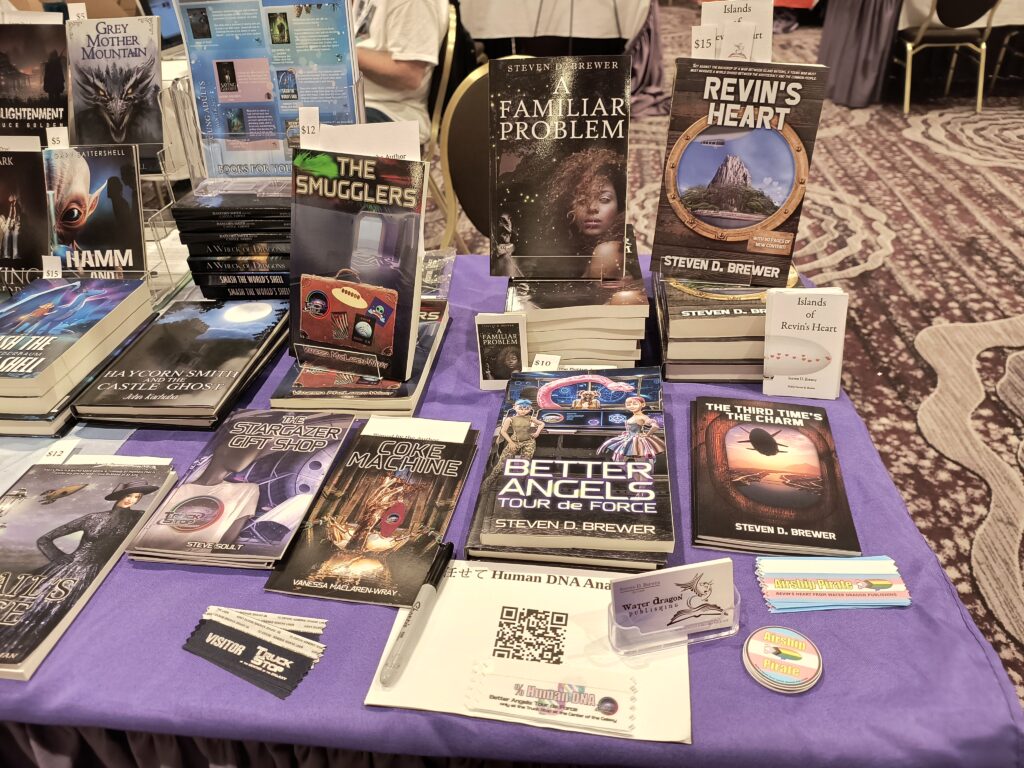
At Worldcon, I got the chance to chat with Roxana Arama, the editor of Planetside (formerly the SFWA Blog). We had a great conversation and she encouraged me to write a pitch for an article.
Upon reflection, I decided to pitch an article about hand-selling books for authors as a kind of Bookselling 101. Since I had time in August (and was likely to have less time once the academic year started), I went ahead and drafted the article even before my pitch was accepted, figuring I would post it to my blog if it didn’t get accepted.
My pitch was accepted, but with a modification: They wanted a Bookselling 201 article and were most interested in having my expand on the aspect about pitching and hand-selling books. I made the necessary revisions and the article, How to Hand-Sell Books for Fun and Profit, is now live at Planetside.
I thought it would be fun to share the rest of the Bookselling 101 article I wrote here.
Where to Sell
There are a large number of opportunities where you might be able to sell your books directly to an audience. Perhaps the most important are the national and international conventions, like Worldcon, Dragoncon, and Comicon. Regional and local conventions are also worth attending. Additionally, there are often a vast number of local events that will welcome an author selling their books, including festivals, artisan markets, and holiday markets.
Conventions usually have a “dealer room” where most of the bookselling happens. Dealers pay a charge to have a space in a room with other dealers where they can sell their wares. For an individual author — especially a beginning author — the charges for a table may be higher than are warranted. But there are sometimes ways to share the cost. It may be that your publisher will already have a table. Or will pay to have the table, if you volunteer to help staff it to sell your books and others from the publisher. Some groups, like Broad Universe and Small Publishing in a Big Universe (SPBU), offer tables that multiple authors may join and share. Many conventions also offer other opportunities for individual authors to sell their books, in an “author’s alley” or via book-signing events.
Your Personal Brand
Presenting yourself and your books effectively makes a good first impression. Branding works. Many authors use some props to create a distinctive author appearance: a distinctive hat, like Tobias Buckell’s beret, or a T-shirt with a graphic design that evokes or aligns with your brand. A tablecloth and tablerunner, or banner, with branding are worth having to give your bookselling operation a polished, professional appearance.
Branded giveaways are useful to remind people about your books after they’ve walked away from your table. A business card, with a QR code linking to your website, is a no brainer here. But there are a lot of other easy and fun possibilities. Bookmarks are an obvious choice. Stickers can be good, although they’re more expensive and some venues ban the distribution of stickers. Some conferences use badge ribbons and, if you can think of a catchy hook, they have the added advantage that other attendees may see other people wearing the ribbon and will come to your dealer table because they want to get one of their own.
If people purchase several books, it’s convenient to be able to offer a bag to help them carry their books away. Be aware that in some localities, disposable plastic bags are outlawed, so paper bags are safer. The bag is another opportunity for branding: A rubber stamp works well, but stickers or labels can do in a pinch. Alternatively, you can purchase some branded reusable bags to sell.
Practical Concerns
Books are heavy, so a collapsible cart or wagon can be invaluable for moving your books and other materials during load-in and load-out. Stout cardboard boxes are ideal for protecting your books. But high quality reusable grocery bags with a flat bottom are convenient too and have the added advantage of handles. Book stands are also useful for standing up just a few books to highlight. (They’re also useful for when you’re a participant at a panel, to show your books while you present!)
It’s fun and easy to also sell books at outdoor festivals and markets, but you need some additional resources. You will probably want a collapsible 10×10 foot tent. Some are much easier than others to transport and setup by single person, so consider those factors when making your selection. Also, be sure to get some weights so that your tent doesn’t blow away in the wind. (Ask me how I know this…) You’ll need a table and some folding chairs. Usually tables and chairs are provided in dealer rooms, but for most festivals, you’re on your own. An 8-foot folding table works well. But two smaller tables — or just an additional table — can provide some flexibility.
Hand Selling Books
The most important thing I’ve learned about bookselling is that a concise, polished pitch for your book greatly increases your chances for making a sale. My article at Planetside, How to Hand Sell Books for Fun and Profit, goes into more detail about this.
Financial Concerns
Before selling anything you should make sure you have your financial ducks in a row. If you are selling on behalf of another organization, like your publisher or SPBU, they may have taken care of these details beforehand. Otherwise, you should consider setting up a separate bank account for you to keep the finances of your bookselling operation separate from other activities.
Honestly, if you’re a professional author, you should already have a separate bank account for business income and expenses. But, if you’ve resisted that up to now, stop resisting — you really need that, if you’re going to be a book seller.
Before you start selling, you will probably need a Tax ID number in order to collect and report sales tax. The rules and the amounts can vary widely depending on the locale. The rules for this vary from state-to-state or even city-to-city, so be sure to check the laws carefully in your locality.
You will need to accept payments. There are a few payment processors that offer inexpensive integrated systems you can use as a Point-of-Sale terminal. Many cell phones now can accept NFC (tap) payments with one of these using a card or phone or smart watch. There are also inexpensive devices that can accept tap payments, but allow someone to also insert a chipped card. These systems generally impose a 3-4% charge, which you will need to price your products appropriately to cover.
Different events bring people with different preferences for how they want to pay. Most transactions are usually via credit cards but, at some events, many people will want to pay cash. An envelope containing small bills is useful and that can also hold the cash collected. I usually start with $100 in one, fives, and tens to make change. I can then easily calculate the additional cash collected by the end of the event, to confirm it matches the transactions recorded in the payment processing system. Some events and populations prefer yet other payment systems, like venmo or paypal. It’s useful to be able to accept payments using whatever system the customer prefers.
I’ve generally found it convenient to price products at even dollar amounts that include the taxes and payment processor charges. Remember that, if you price something at $11, you will need a large number of ones and fives to make change, if you have many cash sales.
I’ve found that printing price tags on florescent card stock is useful. I have a template with prices along the edges that I can cut in half and then cut between the tags. These are easy to tuck in between the pages of books, so they stick up and are highly visible. You can use the different colors of tags to indicate various things: e.g. price range or genre. People like to know how much things cost. If you don’t have price tags, people will need to ask you, which will deter sales.
So, that’s it. That’s pretty much everything I know about selling books. Yep, that’s pretty much it. Oh, except you need some books to sell. You should probably go write some books now.
Finally Set Up FreshRSS
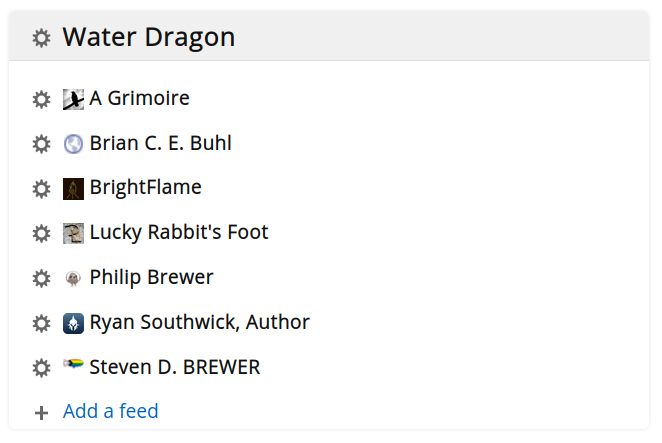
I spent a snowy afternoon setting up FreshRSS at my hosting service. It was a snap. It really only took me about a half hour once I got started and made me wonder what I’d been waiting for. I’ve only just started exploring it’s capabilities, but it seems great so far.
One of my fellow authors at Water Dragon Publishing shared a bit of news at the Discord and indicated she would be providing further updates to her blog, if people wanted to follow her journey. I had been meaning to set up a new RSS feed reader for a couple of years and so this was just the prompt I needed to kick me into gear.
I was an avid user of Google Reader and then, for many years after, ran an instance of TinyTinyRSS (TTRSS) as a feed reader on my home server. At some point, however, TTRSS began to require Docker. When I tried to set it up, it didn’t work right — probably because I got something wrong in the Docker configuration — and I said, “#@&% this!” I wasn’t going to teach myself Docker just so I could play at being sysadmin.
I tried a few other app-based feed readers, but I really wanted something server based. Otherwise, you really can only check your feeds from a single device and I switch among three devices pretty much constantly. I had identified FreshRSS pretty early on as a good candidate, but I wasn’t sure it would play nicely with my hosting service. I had tried to install TTRSS there and that hadn’t worked (which is why I had been running it on my home server).
In the end, I just did it. I downloaded the source, checked the documentation, and got started. I re-used the domain name “feeds.bierfaristo.com” that I had created a few years ago and added hosting. I scp’ed the tar file, untar’ed it, and the pointed my browser at the URL. Bam! I was in business.
I had saved an OPML file of my old feeds, which I went ahead and imported. It was a trip down memory lane. A lot of the feeds were dead, but a surprising number are still good. I’m looking forward to being more intentional about keeping up with feeds again.
Some Extra Tanuki Time

I have gotten essentially no fiction writing accomplished during this Intersession. My university contract says most of January is a period of non-responsibility so each year I can usually get a lot of writing done in those weeks. But this year, my mentally ill adult son was hospitalized for the first time in four years.
I’m not going to write about his mental illness diagnosis or experience. As my wife would say, that’s not my story to tell. But the impact it’s had on our family does feel like my story to tell. And I think it’s important to share, because many people shy away from talking about mental illness in our society because they’re ashamed. The demands his chronic illness put on our family may be less visible, but they are very real.
For the past two years, he’s lived independently, though fortunately close enough that either my wife or I can visit daily. We had expressed growing concerns and uneasiness for several days before he was hospitalized and tried to provide nearly round-the-clock support. I stayed with him during the day and she stayed with him in the evening, including hanging out on his couch one night. But, in the end, after about three days, he still needed to be hospitalized.
This is the fourth time he’s needed hospitalization over the past seven years, but this is the first since he began living independently with his emotional support animal. While he is hospitalized, care for her has fallen to my wife and me — in addition to following his care, ensuring all of his professional supports are coordinated and, of course, one of us going to daily visiting hours to see how he’s doing and (struggle to) stay connected.
For me, taking care of his young dog is a genuine pleasure. She’s a little weird, but boxer dogs are always a little weird. On the one hand, boxer dogs are so similar to one another, they might as well be clones. But, on the other, they all have unique idiosyncrasies. She is adorable, and I love her to pieces.
That said, it’s been hard. Trying to keep track of another set of needs is almost more than I can handle now. Despite masking everywhere, my wife has a bad cold that’s interfering with her job. It’s been rough.
I was really disappointed for myself and other panelists that I felt compelled to withdraw from Arisia. I had been scheduled to moderate one panel and appear on four others.
Still, I have managed to accomplish a few things. I submitted my application for the Lambda Literary Writers Retreat. My article about bookselling, How to Hand-Sell Books for Fun and Profit, appeared at Planetside. I’m scheduled to read from A Familiar Problem for the Straw Dog Author Showcase on January 31. And I got my university course website published on schedule, one week before the start of classes for Spring 2026.
Yesterday, due to the massive winter storm, I could not safely attend visiting hours, so I used the time to install FreshRSS and take a nap. I also managed to write a story fragment for @wss366. I’ve only managed about half the days since this all started.
Every day of hospitalization is a trial in multiple ways. The dog — and all of us — want my son to be ready to come home. We’re doing the best we can for the moment, making sure she gets lots of love and walks and treats. But it’s hard for her and hard for us. And still will be for weeks after he does return to his place, as he recovers. She is ready to do her part doing what she does best, providing unqualified emotional support. She is ready.
